
Jalousie, Allyson Paty. Tupelo Press, PO Box 1767, North Adams, MA 01247, 2025, 68 pages, $19.95 paper, www.tupelopress.org.
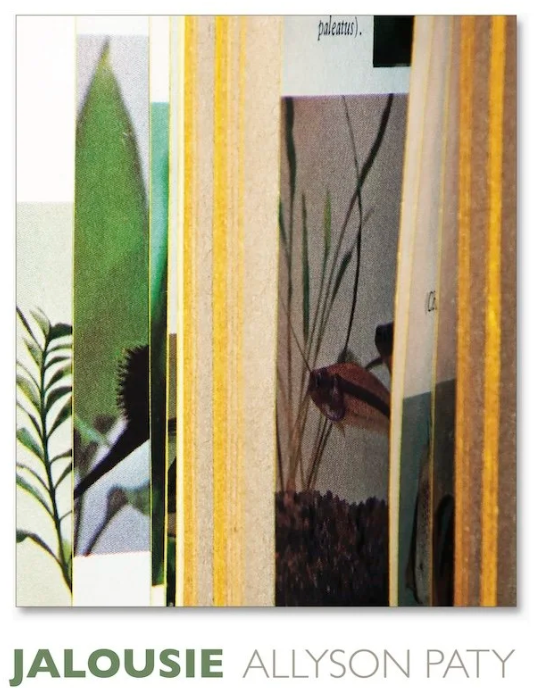
At first I thought the title of this poetry collection, Jalousie by Allyson Paty, meant the kind of window made up of glass slats that tilt open within a frame, slats that look like blinds in structure but that comprise the window. Sometimes frosted, sometimes clear. Glass louvres. But in the introduction by Diana Khoi Nguyen, who selected this collection for the Berkshire Prize, a jalousie is described as a type of window treatment, like a cross between blinds and a curtain. Something to stand behind and be obscured by while observing the world. These days, when shameless exhibitions of power and ignorance are stealing much, it is easy to think that a quiet poet opening the window on a subtle consciousness doesn’t ask much of us. We are not starting a revolution or shouting down authoritarian overreach through this poetry. Instead we are breaking into an apartment of inner awareness.
Since I was initially thinking of the window meaning of jalousie, the idea of this collection made me think of Jean Valentine’s collection Break the Glass but seemed to promise an easier way to get in. As though, rather than breaking anything, we could just tilt the slats and open the window a bit. Breathe. But maybe it’s a strange comparison to put these two poets in juxtaposition. Where Break the Glass overflows with presences, Jalousie pulls us through lyric absences. There is, however, a definite anti-narrative streak that connects them. Let the movie of my life be episodic, arcless. / All the dressing and undressing stitched together, begins Paty’s poem “Self-Monument.” These poems manage to tilt the blinds to reveal the undressed mind, with interior reflections melding with those outside.
Paty is a poet based in New York City, and, as Valentine does sometimes, she gives us the disorienting sense of the metropolis’s undercurrent of thought and beingness. From a poem early in the collection titled “In Medias Res”:
standing on the roof
my face
and the face
of the buildings
I say my city my gaze
no the body the city
the face with its eyes
under the bald sun
they pass through one another
Through her images and through the deliberate design of the lines of each poem, Paty accomplishes this: bringing us close enough to breathe the same quiet, terrible air.
Firstly, images. Visual, emotional, auditory. In a poem titled “This Was to Be,” we see the overloaded cheese platters at university social functions, we feel her boss’s disdain of a film that featured poolside characters with no “inner life,” and we experience an overheard locker-room conversation about an absent acquaintance. Examining what’s inside and then outside, then inside again, with emotions ricocheting off the poem’s lines like the inner rail of a pool table, Paty shakes us awake to the mimetic fault lines of our daily-use minds. From the shower I hear one say to the other / When someone tells me something I want to do / I believe it. And in this poem we can sympathize—it is universally human to get swept up in the desire vortices of our social scenario. Other poems in the collection walk us through the nuances of getting swept up, as in “Promenade.”
and crossing
your path
is a woman
in low-slung mules
you want
what she has
easy limbs and
deft gait
but don’t you
already have it?
the wash
of grasping
a go-to
Our wants are given to us, refractively, and it’s a rare moment that we even get a peek at the information-age-induced, mirror-neuron overload inside our heads.
Let the movie of my life be episodic, arcless. / All the dressing and undressing stitched together
Jalousie invests in nervousness with a lot of attention, and the payout is pretty good. It really is only a human thing to have nerves that get frayed and then ignored out of necessity, habit, or a misplaced sense of kindness. The poem titled “Premise” opens with a perfect introduction to the undercurrent: Having woken from the dream of riding on a flat tire / Having carried the scrape and-a-one-two, scrape and-a, scrape, scrape onto the train. Paty examines this undercurrent of nerves in two ways: as though it were a curtain over the daily mind, which can be blamed for obscuring reality, or as something that can create opportunities to draw back the window coverings, to see and to be illuminated.
The poem continues its walk to work, moving us past a woman asking for spare change, past mall-like avenues, and past this scene:
Having passed two men caked in dust, one
Having aimed a miniature leaf blower at his chest
Having turned it on his companion, who
Having swept his arms dramatically
Having pushed the tool gently away, both men
Having laughed, somewhat cleaner
Later in the poem, through her lunchtime routine, she recalls the small drama between the two men on the street and starts having an inner debate about whether their shirts had been orange or not. But then the reflective mind does its thing and moves out past details:
…the men this morning
Having cleaned via pantomime of cleaning
Having slid tenderness inside a macho exchange
Having rendered the image of a rough touch via a light one
Another strand of daily-mind nerves that Paty follows in this poem starts at a yogurt cup that she’s about to “recycle” in a bin that she’d seen emptied into the same dumpster as the regular trash. Rather than be utterly depressed by the desire-vortex of consumerism and [h]aving read that plastics remain 450 to 1000 years intact, she takes us on an investigative Google search, first to the year 1569 for [h]aving wanted 450 years to feel real or specific. Eventually her search for something human made and intact from the year 1019 yields only a single artifact: in the Met’s digital collection, a gold dinar minted in modern-day Afghanistan [h]aving one smoothed and slightly cracked edge, the details / Having been effaced, perhaps / Having sat unevenly under heat or weight or water and then, well, what then? Paty observes something else:
Having felt the air in the office suddenly thicker, the skies
Having opened, I was certain, despite
Having been nowhere near a window
Having thought the rage of the gods despite
Having not once considered divine emotion as
Having shaped the observable world
Having inherited instead a humanism in which there are natural forces and people who act and
Having felt that worldview scrape and-a scrape, metal rims
Having bent against road
Because images only go so far and may leave you with a flat tire on the side of the road, Paty brings poetic structure to the rescue, very often in the form of single-line stanzas. Or maybe it’s more accurate to describe these as singular lines in space, aware of the light and air that moves around and through, like open, louvred windowpanes on a mild day. It’s not in every poem, but the use is deliberate, effective. Even in one titled “Love Poem,” where we might expect couplets or something more energetic as a poetic line, Paty uses these single lines, neatly spaced from each other. An excerpt:
I’ve been given the idea
of machinery and material and human work—nothing
specific as the fact
of this one shirt (it is here and present) on your body the body I touch
and live beside
like any god this binds me
to the knowledge that my knowledge is made incomplete
Too easy to lose track of that knowledge when we live in the daily mind, but Paty uses her poetic image and structures to reveal her own efforts and so open the way for us to do the same. Her effort on Instagram, posting her daily personal garbage (@trash_days), gives a whiff of confessional poetry but with absolutely no puffed-up posturing, only a severe intimacy of daily awareness, which is probably the only thing that could ever hope to work against the envy machines driving consumerist culture.
Today I woke my worst, wanting nothing but blamelessness, / the coward’s lonely itch.
I think it’s worth mentioning that I looked up “jalousie” on Pinterest to try to find out what a window treatment with that name looks like, but I instead ended up with a bunch of memes and blog posts in French about coping with jealous friends and “syndrome d’Othello.” Jealousy isn’t really one of the themes of this collection, except for maybe one poem. I was pleased instead to find in Jalousie an ecopoetic mood that doesn’t deal in outrage but in deepening pools of self-awareness and resistance. In “Replica,” Paty pulls us out the door and into the rain: Compelled to admire the manicured gardens of pathological control, / I go narrowly, on a wet day, clutching a pet disdain, and deep into inner terrain: Today I woke my worst, wanting nothing but blamelessness, / the coward’s lonely itch. Wanting comfort, wanting something pleasant, wanting to erase complicity.
But then joining the plastic rain-bonneted heads on the corner, the poem leaves us without analogy and thus abandoned to reality. I think we all want to avoid taking the envy bus and instead to just walk to work like that.
A. Anupama is a Tamil-American poet, artist, and translator whose work has been published in Prairie Schooner, Tupelo Quarterly, Numéro Cinq, and elsewhere. Her poetry chapbook, Saffron Threaded, is available from Dancing Girl Press. Anupama lives with her family in Upper Nyack, NY. More about her at aanupama.com.