
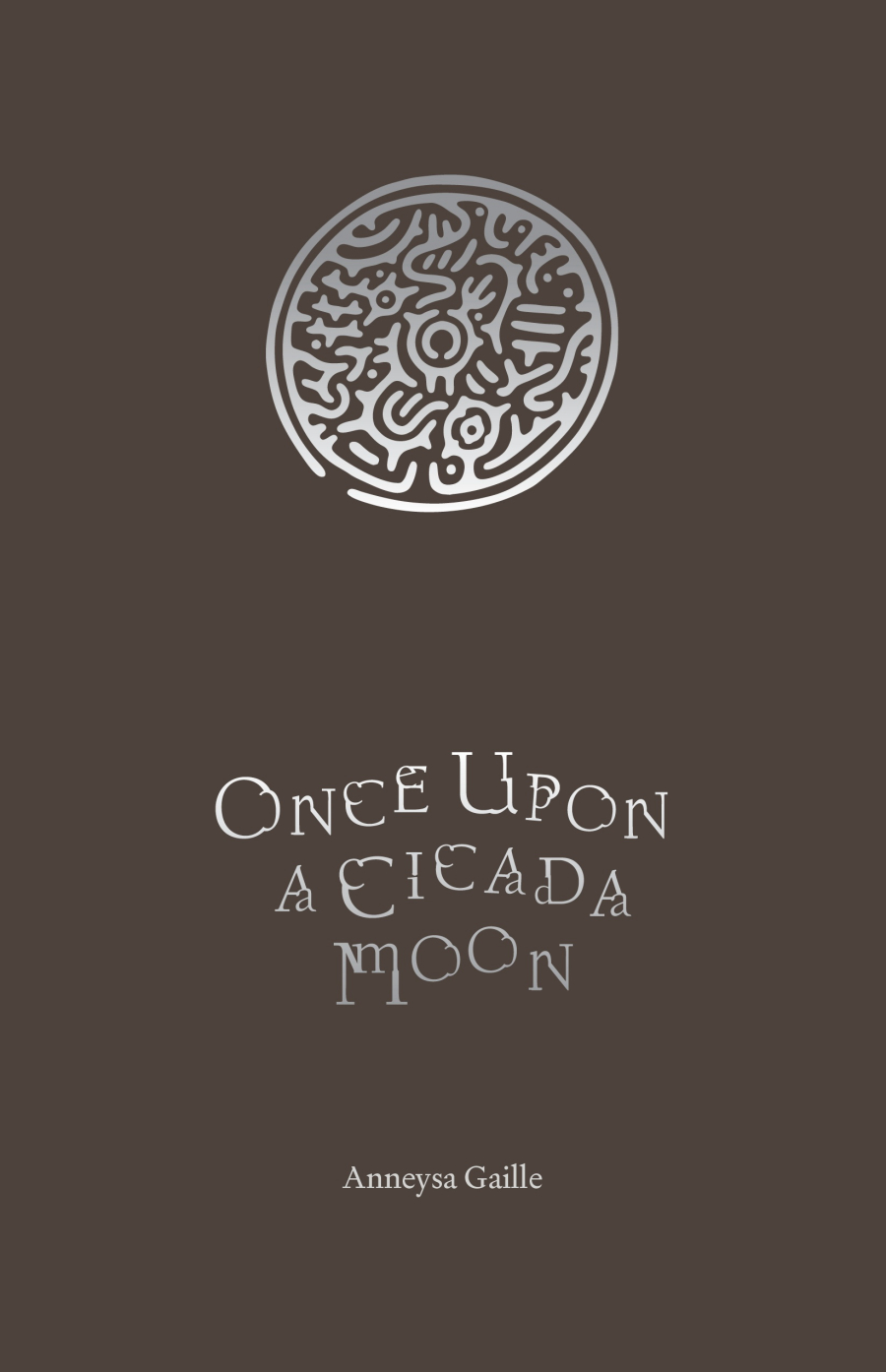
ONCE UPON A CICADA MOON, Anneysa Gaille. Tender Buttons Press, 435 West 22nd Street, New York, NY 10011, 2025, 84 pages, $22.00 paper, www.tenderbuttonspress.com.
Tangled roots perplex her ways. How many have fallen there!
—William Blake, “The Voice of the Ancient Bard”
Part folklore, part ballad, and part long-form poem, Once Upon a Cicada Moon by Anneysa Gaille is a feminist, visionary, and experimental first book. In the author’s note, Gaille writes that her home state of Texas has the highest number of rape cases in America, last reported in 2023.
This is the truth Once Upon A Cicada Moon rises to expose—the voice Gaille unknowingly opens her medium for. Together, they invent a form: “The Balanchine.” The spaces that linger and collect in these pages are necessary circulations and invitations for the emergence of voices silenced by sexual assault. After all, female cicadas have waited long enough for their own song.
The cover is a stunning silky matte—the kind that leaves a mark wherever touched, which feels alchemical for a tale haunted by unwanted touching. As readers, we enter through Flore Thevoux of Jegayo’s illustration that resembles a storm drain grate and a gateway to the cicada moon, or The End. In three parts set mid-page and unpunctuated, the body of the text flows as a boundary that shapes the banks of Buffalo Bayou, itself a treasured ecosystem threatened by deforestation, pollution, and collapse.
Prayer can be applause for all
In Part I, the voice’s separation from her body is confirmed with the image of an ambulance without / sirens and hunting grounds of bluebonnets, Texas’ state flower. Down the storm drain, Balanchivadze in His snakeskin boots and Muse (who I imagine in pointe shoes), signify how binary archetypes can ensnare collective consciousness—how the haunting weaves the hunting. The presence of Mockingbird tracking voices lost to sexual assault in Part II (How many have fallen there!) underscores the senseless repetition of violence ad nauseam and, somewhat paradoxically, an opportunity for cyclic disruption.
The horror is that this chorus of tongues, torn out with haste & without care in Part III is not exceptional, happening to the point of stumplimity, a reference to Sianne Ngai’s term that resists transcendence toward unrepresentable divines and pulls us downward into the denseness of language (“Stuplimity: Shock and Boredom in Twentieth-Century Aesthetics”).
Like William Blake, Gaille does not avert her eyes from paradoxical visions like hardened amber that yearns to slouch away from / everything frozen inside but dances through time spent inside echoes with fresh experience. She intuits when language cannot balance the weight of what we have lost. Close listening, information-channeling, and poetic expression are all methods of experimentation Gaille refuses to overlook by looking again.
Often, the leap in unlocking a world as Gaille has done is propelled by belief. I’m grateful Gaille believes that prayer can be applause for all because no / one salvation provides true salvation. Perhaps tellingly, the voice of Gaille’s communion calls for Mama.
A precious difference between poets and detectives is a poet’s predisposition for uncertainty. Gaille’s preservation of silence alchemizes our experience with it as muscle, revealing voices we need to hear and remember with care. The lyrical cadence of Gaille’s lines demonstrates that dream language is at least as vital as that of waking life. Isolation is an empowering mentor and can become a mirror for hidden interlocutors on the far side of silence. This debut from Tender Buttons Press unearths how the ways we choose to reach for and inspire each other transform no less than worlds.
Erika Kielsgard’s debut chapbook, Lamprey (Harvard Square Press, 2024), was selected by Diane Seuss as winner of the 2023 International 3-Day Poetry Chapbook Contest. Her work has found generous homes in Bone Bouquet, Cleaver Magazine, Cordella Magazine, Mantis, Volume, and others.