
ALMOST NOTHING: RECLAIMING EDITH FARNSWORTH, Nora Wendl. University of Illinois Press, 1325 South Oak Street, Champaign, IL 61820-6903, 2025, 152 pages, $19.95 paper, https://www.press.uillinois.edu.
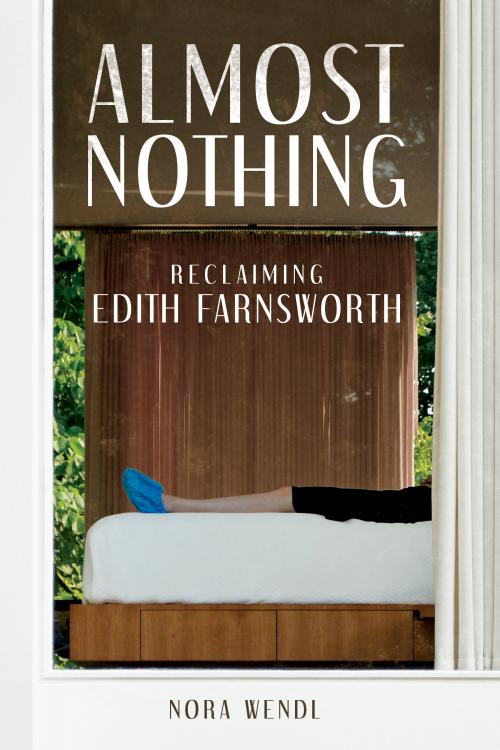
The Farnsworth House is an icon of modern architecture. After a model of the house was exhibited at the Museum of Modern Art in 1947, it was built for Edith Farnsworth by Mies van der Rohe (commonly referred to only by part of his last name, Mies) in Plano, Illinois, an hour outside Chicago. The glass-walled, one-room house was an early adumbration of Miesian theories of architecture such as “less is more.” When the author first sees it, it looks to her not like a house but a land-locked ship.
Many historians have seen the contentious story of the Farnsworth’s house construction, which descended into litigation due to overrun costs, as a result of a thwarted love affair between Dr. Farnsworth and the married Mies van de Rohe, though there is no clear evidence to prove that. In Almost Nothing, architectural historian Nora Wendl changes the narrative around Edith Farnsworth by changing its form. Wendl’s book is a heady hybrid of architectural history, biography, autobiography, philosophical meditation, and description of several road trips, as she travels far and wide to research the book and renew her own academic career.
Almost nothing… was his concept for her glass house. Almost what—almost God?
The relationship between modernist architect and client is often contentious (see: Frank Lloyd Wright). In the case of the Farnsworth House, there were other grievances besides the cost. Mies’ insistence on building the Farnsworth House—now called the Edith Farnsworth House–in a flood plain resulted in the house being flooded right after it was built in 1950 many subsequent years, requiring extensive renovations.
Perhaps to Mies van de Rohe, Edith Farnsworth represented a flood of a different sort, a strong-willed, independent woman. Farnsworth (1903 – 77) was one of only four women in her medical school class at Northwestern. She specialized in nephrology and made major contributions to the field.
As a then-rare female physician, Farnsworth faced additional pressures to the inherent stress on all physicians. She was lucky enough, coming from a prosperous family and being in a high-paying profession, to afford the land on which the house stands, as well as the money for building the house, at least under the originally stated terms. The one-room house was designed as a weekend retreat is an unbroken space (except an inner core housing the bathroom and the house’s mechanical systems) enclosed by glass walls. The effect is to make the home seem entirely permeable to nature, with unobstructed views of the woods surrounding it and the nearby Fox River. The author remarks on the capacity of glass to render the world beyond it silent.
Despite their financial disputes, the architect and his client seemed to share a vision for the house. Wendl details the philosophical sources of Mies’ design philosophy in the nihilism of Nietzsche, one source of the book’s title: Almost nothing… was his concept for her glass house. Almost what—almost God?
The book is another act of construction in which the author dramatizes her discovery of Farnsworth’s unpublished memoirs and poetry while simultaneously re-establishing her own professional identity as she travels from her academic post in Portland, Oregon, to a new job teaching architecture in New Mexico. The braiding of her story in the 2020s with that of Farnsworth in the 1950s highlights and counteracts the ongoing exclusion of women from history, especially the history of architecture as patrons, designers, architects, and architectural historians.
Wendl interrogates the very nature of architecture as a negotiation between human and natural environments. But her book goes further. It is a meditation on identity, especially female identity, in the light of environment, history, and death.
Wendl shows how Farnsworth has been nearly written out of history in favor of the narrative dominated by the “master builder” Mies van der Rohe. In the second half of the book, Wendl describes the exhibit Edith Farnsworth, Reconsidered mounted at the house from 2020 to 2022, when Farnsworth’s first name was restored to the house’s name. Wendl found the exhibit incomplete, however. This book is an act of restoration of Farnsworth’s history and identity a decade in the making.
Wendl’s most powerful tool is quotation from Farnsworth’s own writing. In an essay Farnsworth wrote about Mies at his request, she states that for him, structure was the sequela of the material. Wendl unearths Farnsworth’s unpublished memoirs at the Newberry Library in Chicago, where access is open to anyone, and quotes from them at length. She also cites many of Farnsworth’s poems and translations of other poets, mostly from Italian. Farnsworth’s poetry shows her love of imagery and appreciation of the natural world, which make her the ideal inhabitant of the glass house: (Space is dark, windless, leafless and unblooming / in the micro-universe, // perhaps you saw all this, you too.) Wendl restores Farnsworth to her place not only as client, patron, and co-imaginer of the house but to her rightful place as its subject, the person who found living there ennobling despite the issues around its construction.
Wendl meditates extensively on the transparent and reflective qualities of glass, its strength and fragility: …in truth, there is no inside or outside to glass. There is just space, unfolding forever, and an invisible wall that our hand hits when we reach out for something we cannot have. That meditation expands into reflections on identity, especially female identity: I move toward considering things I can control. The invisibility. I think about it every day…. I think about it in my glass-enclosed faculty office…. In place of invisibility, I could try reinvention. The author describes how she transforms her own life and career to land a tenured teaching post in New Mexico. Along the way, she includes a vignette from the pandemic, when she and her masked parents experience the strange sensation of fear of family members. She shows a similar and complementary fear of family alienation, this time caused by geographical distance, in Farnsworth’s letters to her sister after Farnsworth moved to Italy in 1968.
Both the author and Farnsworth led independent lives, rare in Farnsworth’s time and still difficult for women in 2025. In the last part of the book, the author almost literally restores Farnsworth’s perspective by including pictures of the house as it was restored in 2020 to approximate the way it looked when she lived there.
Wendl counteracts all-too-familiar narratives imposed on Farnsworth from the time of the house’s construction in 1950 to the present. The transcripts of the trial that the author obtained with difficulty show Farnsworth’s story repeatedly undercut by Mies’s lawyer and the judge. Historians’ insistence on viewing Farnsworth as Mies’s spurned ex-lover, perpetuated even by a current writer, gives way to the story of a woman who was as much a genius as the architect who designed the revolutionary house for her. Wendl’s book conjures back into existence their shared vision of a Utopian existence lived with full sight and insight, as symbolized by those glass walls.
Elissa Greenwald taught English for thirty years, then earned an MFA. Her poetry, creative nonfiction, and essays have been published in such journals as Blueline, Brevity, humana obscura, and Rockvale Review.