
NO MATTER HOW IT ENDS A BLUEBIRD’S SONG, Kat Lehmann. Rattle Foundation, 12411 Ventura Blvd, Studio City, CA 91604-2407, 2025, 44 pages, $9 paper, www.rattle.com.
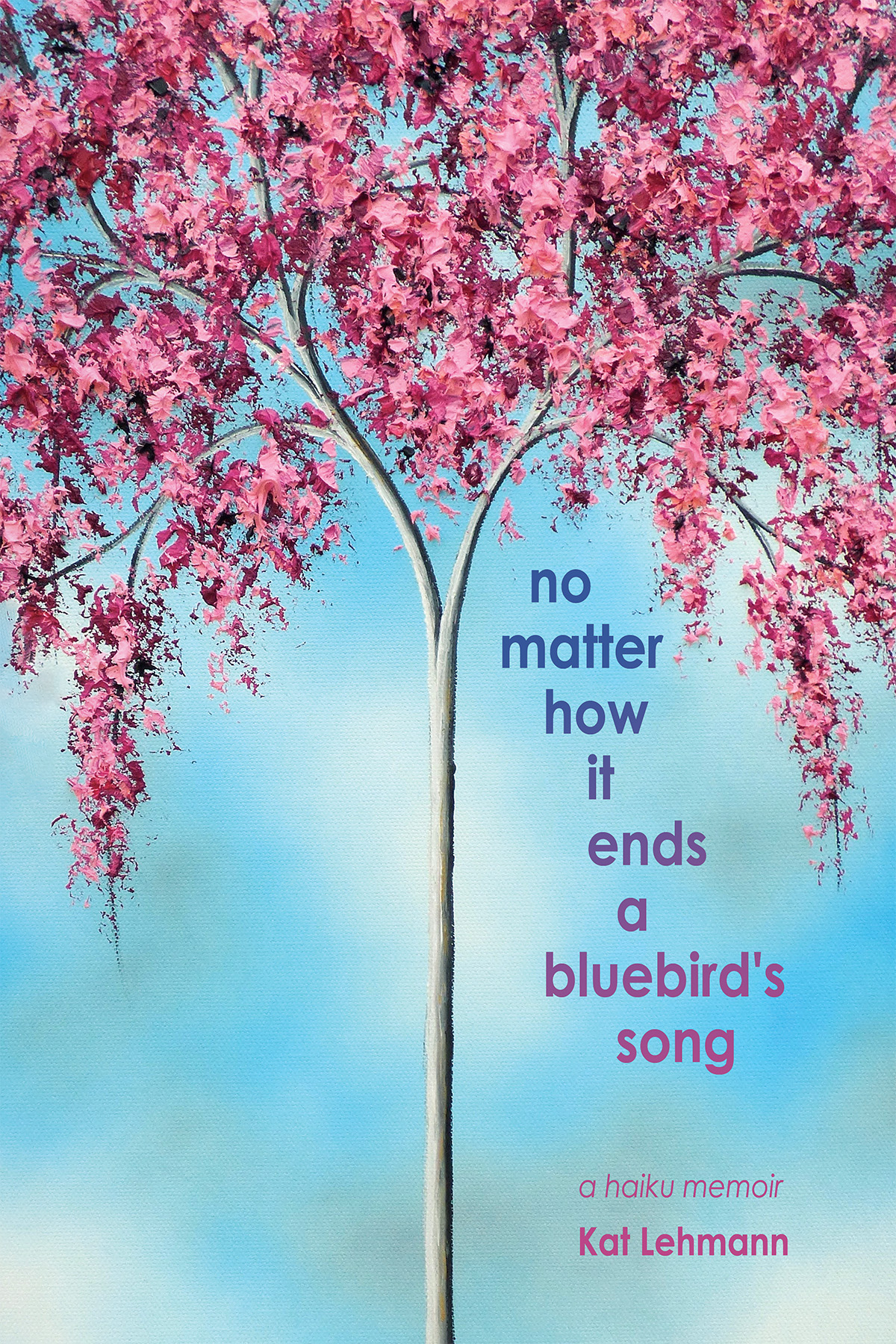
No Matter How It Ends a Bluebird’s Song lilts across the pages much like a bluebird’s song, short and sweet, while holding the impact of unexpected juxtaposition. Each stanza and line represent a common emphasis on the haiku’s ‘turn’ in their juxtapositions of the body to natural image and metaphor. Yet Lehmann’s haiku memoir doesn’t strictly conform to the boundaries of contemporary haiku. Instead her poetry flits into the realm of the visual as her words manipulate both the boundaries of poetic form and the composition of the page. Her words often border on intentional illegibility, visualizing the lived experiences of a body turned illegible and cast into flight by illness, subsequent medical treatments, and medication side effects.
I fell in love with the way in which Lehmann uses haiku’s inherent connections to image and metaphor to create fragmented moments of a world turned unknown. She begins her poetic memoir with the following chain from “1: trail.”:
two
days
after
the
first
dose
the
world
falls
into
starlings
The words self-reference in their act of falling downward, as if cast adrift by wind. While the world [falling] into starlings remains an interesting and unexpected image in itself, the use of space crafts her words into a natural phenomenon. Like a feather falling gently, tossed to and fro with the wind, my gaze was ushered farther along the page and into Lehmann’s transformations of her body and world into natural metaphor.
She again accounts for the visual in words from “4: clinic.”, where her poetry transforms, in this case, into the sharpened silhouette of needle:
blue
butterfly
needle
tip
of
the
scar
on
this
rem
ain
ing
ve
in
.
She presents us the image—in text—of a needle pointing toward the remaining page’s haiku in which she further depicts the torn vein as a Pollock / of the sheets. Each word is provided the space to stand on its own, allowing readers to interrogate the connections, or disconnections, between words such as blue, butterfly, and needle. As the words fall into fragmented illegibility, we are led to briefly lose ourselves toward an ambiguous ending. A period, while conventionally signaling an ending or pause, visually transforms into the tip of a needle, becoming a vessel as much as an exit and entry point. We are then injected further into an extended visual metaphor of poetry as a sharpened needle with the capacity to break boundaries.
One of my favorite moments in Lehmann’s memoir was her traversing of boundaries, of returning to the legible, in “8: returns.”:
moon my mind
moon by moon my mind pines
moon by moon my mind through the pines
moon by moon my mind returns through the pines1
Her manipulation of text color or opacity creates the effect of her poetry returning from a state of illegibility or the unknown, as if returning into the light. There’s also a sense of motion or momentum in both the repetition of moon my mind and the additional building upon the brief line. Similarly, there comes a movement in the shifting perspective from the mind itself as a moon—supernatural, distant, and of the dark—into a personified mind to return through the pines with the moon as a unit of measure, or reference. When read aloud, the use of alliteration and assonance in this excerpt allows for a smooth rhythm to form, but it’s a rhythm that, with its diction, doesn’t warrant a rushing but an intentional traversing through. If No Matter How It Ends a Bluebird’s Song is read as one overarching haiku, the above excerpt from “8: returns.” then reflects the haiku’s signature turn, or volta, from the fragmented flight of diagnosis and dosage into the return to a hopeful and recognized body and world.
Lehmann divides her haiku memoir into the following nine poetic sections: “1:trail.,” “2: room.,” “3: fatigue.,” “4: clinic.,” “5: shadowwwww.,” “6: reaching.,” “7: shake.,” “8: returns.,” and “9: here.” She then presents a journey broken into haiku-esque moments, a flight that readers are meant to physically visualize on the page as much as internally imagine.
Throughout, Lehmann balances the sharp tension and unnatural images associated with illness and medicine with the peaceful comforts of natural metaphor. Her body at points is a river cloud and less than a cloudless sulfur adrift in an illness, while at other points her body is of sea-smoothed stone and the world a tree cathedral. At times the body and the world morph into one, and Lehmann touches on the notion of how one’s lived experiences within their body truly construct their world and perspective. No Matter How It Ends a Bluebird’s Song is a resonant work of haiku memoir that requires us to approach and experience Lehmann’s imagery-rich world of the body with an open-mindedness to illegibility to return to our own worlds anew.
1 Quoted material, especially the excerpt from “8: returns.,” does not follow the conventions of block quotations in the attempt to best replicate their original printing and visual formatting.
Chantelle Flores (she/her) has academic and creative work published or forthcoming with Aisthesis, Barzakh, The Cypress Review, Scribendi, and Spire, among other journals. She has recently been awarded the Steve Grady Prize for Undergraduate Poetry and LSU’s Fusion Editor’s Prize for Nonfiction. She currently works as a Writing Center consultant with the University of Maine.