
THE BOOK, Mary Ruefle. Wave Books, 911 E. Pike St., Suite 321, Seattle, WA 98122, 2025, 112 pages, $20 Paperback, https://www.wavepoetry.com.
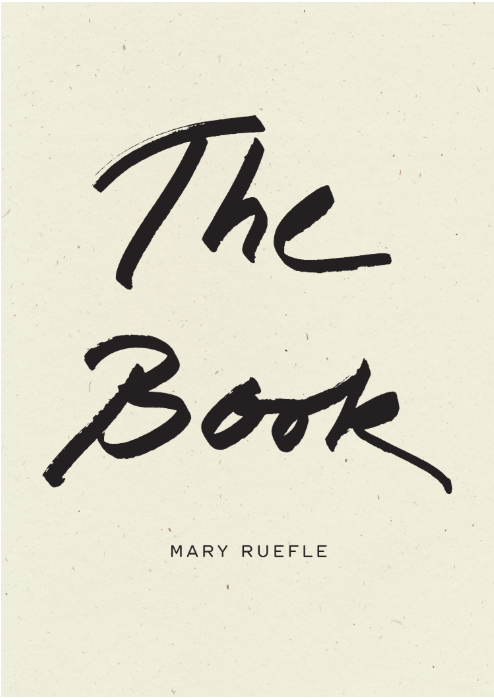
Mary Ruefle doesn’t accept “Mary” as her name in “Untitled,” the first poem of The Book. She wonders if others refer to her as “Mary” merely because they’ve heard others do so. She theorizes her naming originated from another woman named Mary, who maybe isn’t named Mary, either: never once in my dreams have I called her Mary, which, I suspect, is not her name, or if it once was, is no longer. Ruefle selects dreams over reality in “Untitled,” and she will choose it again and again throughout the rest of The Book, a collection of musings accessing the spiritual, emotional truth underlying the visible reality. When one is invisible, language becomes the ideal mode for reflection.
Ruefle is well acquainted with invisibility. She spoke to the Paris Review in 2016 about the loss of identity most women face. As they age, their deemed value of youth and beauty dematerializes. But rather than ascribing loss to change, Ruefle embraces the freedom of fluctuating. In the interview she says, you come into a new kind of autonomy that you simply didn’t have when you were young…. you didn’t have it back when you were once a woman to be seen.
You have to be irreverent to think you can modify the Sahara in the first place, and sincere in your attempt to do so.
Writing resonates with Ruefle because it clarifies and affirms invisibility. In the same interview, she explains how invisibility affected her writing: When I was young, writing was the one invisible space I had, and it made me very happy because I could become invisible while writing. The magic of invisibility allows Ruefle, now in her seventies, to supersede any prior expectations. One way her writing acts freely is through its unconcern with form. Occupying aspects of both poetry and essay, her invisible body writes beyond fickle concerns like genre. The Book features a fluid spectrum of form, some pieces closer to essays, others resembling poems. Themes on invisibility and naming return in “My Dying Friend,” where she considers the nonexistence of a baby without a name:
I was visiting a dying friend in the hospital and passed by a room full of babies who had not yet been given names…. Those with names had won a bracelet and been taken away. But those who remained were quite interesting, judging by the sadness already evident in their features. What do I call thee, little lamb lying here in a bed of cotton?
As Ruefle visits a life about to end, she sees the lives yet to begin. “My Dying Friend” remarks upon the innocence of being unnamed, comparing the baby to a “little lamb.” Ironically, the nameless baby possesses less life than the dying friend. While nameless, the newborn has yet to begin as a self. The convention of naming serves as the first distinguisher to make oneself visible and interpretable.
By dreaming of a nameless self and a baby prior to its naming, Ruefle experiments with the removal of the most rudimentary self-descriptors. Naming, then, might be understood as the “genre” for a human to be categorized as a person, a book as a tool to categorize life experiences, genres as means of categorizing books, etc. Like Ruefle’s resistance to genre, words refuse to form identity as visible, experiencing freedom by articulating abstract truths.
The Book relates the paradox of identity, pairing the innermost subconscious with the outward constructions of being. Language conveys its own limitations in description and self-expression. For instance, “The Color” reflects the contradictions in writing, where an author (another limitation of language: is it Ruefle or merely a fictional Ruefle?) is stuck on thoughts entirely unrelated to the meaning in her writing. The “meaning” in words spiral into nonsense: how can there be quite a few, if there are few there are few, but wouldn’t quite a few be a lot, quite a lot as a matter of fact? And yet failures to write are written.
When Ruefle writes from a position of invisibility, she acknowledges her authorial death. According to Barthes’ “The Death of the Author,” the author dies when writing begins because reality becomes an interpretable symbol. Writers merely act in gestures, never expressing actual realities. Instead writers arrange pre-existing signs and symbols. Barthes asserts, life never does more than imitate the book, and the book itself is only a tissue of signs, an imitation that is lost, infinitely deferred. Ruefle, cloaked in invisibility, never contests the assertion. “The Heart, What Is It?” affirms her stance on authorial death and fickle language: I knew in my heart that the outer world was without written language and that pages of writing were ultimately meaningless. Like Barthes, Ruefle doesn’t consider reality as imitable through language.
“The Heart, What Is It?” recalls her debate with loved ones over a misremembered Ikkyū haiku. She is left preferring the haiku with the mistake, though acknowledging Ikkyū could care less about the fate of his poem. Again, Ruefle’s stance leans toward the dead author: a text’s unity lies not in its origin but in its destination. Ruefle’s fictional author in “The Color” struggles to write because of the outer world’s distractions, but then the inner world calms “The Heart, What Is It?” when positioned as a reader. The past tense of writing is the author, who does not yet know the fate of their work’s meaning.
The poet Alina Ștefănescu once described Ruefle as having irreverent reverence, aptly reflecting Ruefle’s belief in all art as irreverent. Despite the title’s grandeur, The Book feels no ultimate pressure to recreate literature or Ruefle’s entire life. In “Kangaroo Beach,” a previous piece from Madness, Rack, and Honey, she retells Borges’ visit to the Sahara, when he said, I am modifying the Sahara after picking up a bit of sand and letting it scatter someplace else. Ruefle adds, you have to be irreverent to think you can modify the Sahara in the first place, and sincere in your attempt to do so. Like Borges scattering sand, The Book applies Ruefle’s position of invisibility to reflect a truth that’s been hidden.
Language in The Book addresses the silent tug of memory’s recall. Ruefle’s writing reflects the signs and symbols roaming in parts of the past. “Pixie” unites musings and flashes of happenings surrounding the day of a haircut. Structured like a long paragraph, riffs about a description become intercepted by parenthetical references and reminders. Descriptions of the haircut relate to unrelated facts and remembrances:
I was looking in the mirror at the face of a stranger, a hairless pixie with the ears of an elf, and she so scared me (I had heard you could be frightened to death) I leapt out of my throne like a dolphin (my aunt and uncle lived near the ocean, I could go to them) and ran through the door with curly black lettering (it looked like seaweed to me now).
The language of “Pixie” speaks to itself. Barthes would say her tangible, physical self dematerialized into signs and symbols once written, merely a part of language rather than of reality. Yet, even if unreal, these signs offer connections to other language symbols. The parenthetical thoughts emerge from invisibility to connect with what once was tangible: mentions of a dolphin activates the memory of an ocean; under the duress of fear, the hearsay about being frightened to death echoes.
Ruefle re-examines the past like a reader, rejecting the authorial intent of her former self. In “Teeth of Noon” she affirms this sentiment: Like Youth Itself I did not grasp I was living a dream of exhilarating newness. The concept of newness is graspable retrospectively, after layering the signs and symbols across time in The Book. If life merely imitates the book, then the unity of her life’s meaning is in its destination. Even if the outer world is without written language, Ruefle’s inner life demands it.
Ruby Wang is an MFA student at UMass Amherst and contributing editor for Zona Motel. Their work is published or forthcoming in Buckman Journal, Sine Theta Magazine, AMNLY, Poet’s Row, the museum of americana, and more. https://rubywang.carrd.co/