
THE OTHER SHORE: STORIES, Rebecca Campbell. Stelliform Press, Canada, 2025, 224 pages, $19.99 USD paper, www.stelliform.press.
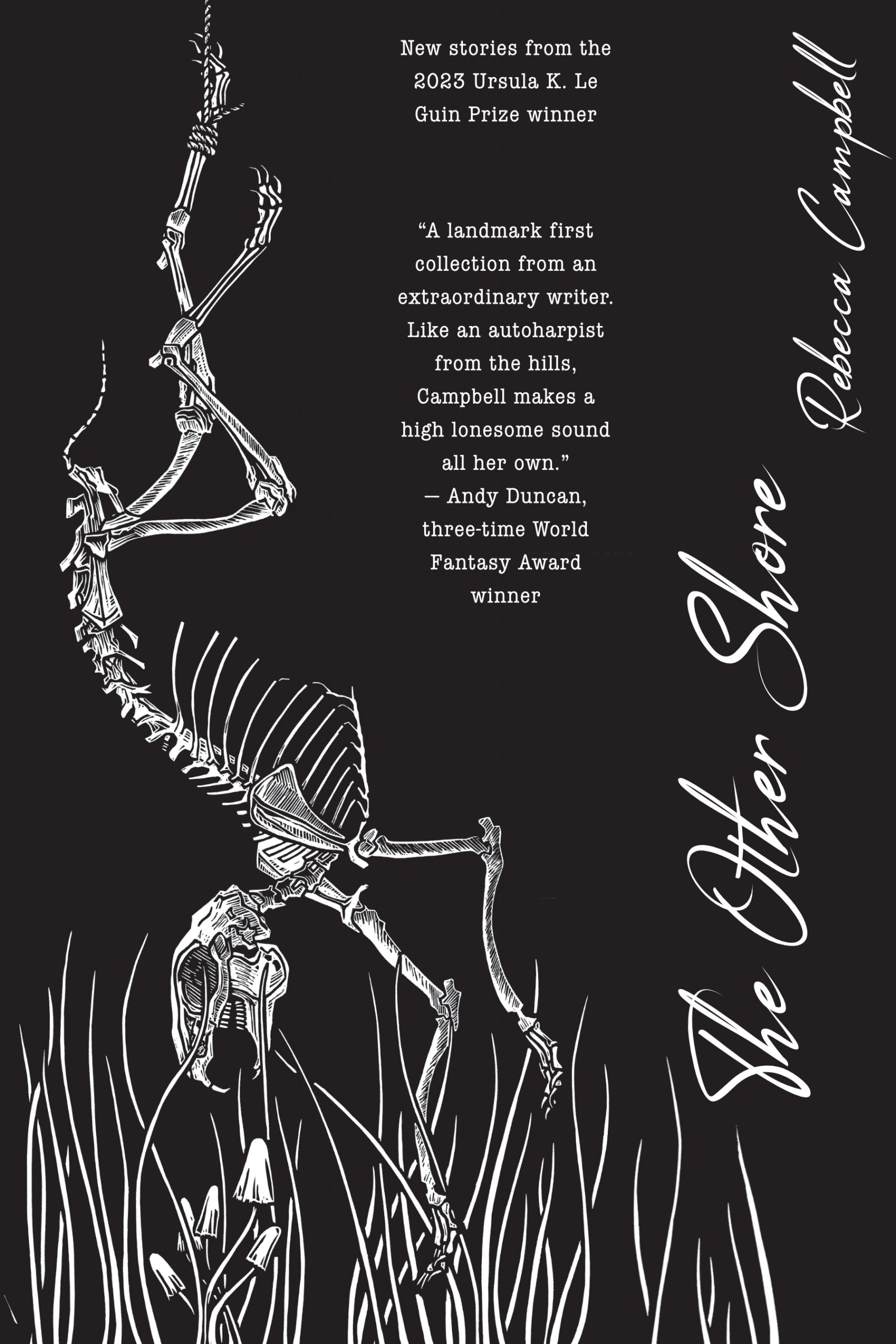
The winner of the 2023 Ursula K. Le Guin Prize for Fiction and a Philip K. Dick Award finalist for her novel Arboreality delivers a truly astonishing collection. Rebecca Campbell, who labels herself “a Canadian writer of weird fiction,” sometimes leads readers gently into the hearts of troubled and lost souls, sometimes pushes us with ferocious energy into terrifying futures.
Begin with the introductions. Readers would be wise not to miss them in The Other Shore. There is an overall introduction suggesting our connection to artifice, our willing suspension of disbelief. A dollhouse is a dream shared between the person who builds it and the person who looks inside. Story intros share not only the author’s dream but the catalyst for it, building a pathway for us to follow into the forest. Campbell goes beyond the whys and wherefores to offer insight into how humanity has understood itself and our world, how it has managed oblivion, how we underestimate our needs.
A dollhouse is a dream shared between the person who builds it and the person who looks inside.
As one example, the brief introduction to “The High Lonesome Frontier” considers a beautiful idea that, despite our personal mortality, our messages may be eternal. At the end of his life, Guglielmo Marconi believed that signals were eternal, still reverberating through the ether long after they passed out of a radio receiver’s range. The story itself revolves in the persistence of sound:
How much they loved these loony, crooning vowels. Words that turned all singers into doves, with billing and cooing that sounded to his ear—he, who had lived so much of his life under the eaves of pigeon-infested houses—like an asthmatic climax. Hoon. Hoon. Hooooon.
Human failure to respect the world we live on is the thread tying these stories into a single view of the world at risk, at least for us. Radiation, climate change, pollution, and experimentation, miraculous births, the arrogance of experimental communities, the campfire tale dismissed as fantasy until it becomes all too real. The title story suggests a past that has not passed and that we might find is impossible to ignore. This begins for the people in the story with a young artist reaching for a dropped button:
Under the water he saw an even earlier village, drowned, though he could make out the fallen poles of a longhouse, and was contemplating its age when he realized that a face returned his gaze.
That gaze is neither benign nor mortal, but a remnant of something greater than all that follows.
The introduction to “Thank You for Your Patience” is a far more prescient warning:
I’ve lived far from the Salish Sea for a long time now, but my mind and heart still live there, a connection that’s acutely painful in crisis. When you live near the Cascadia Subduction Zone, you’re always waiting for “The Big One,” the megathrust earthquake that’s going to happen sometime between this afternoon and five hundred years from now.
Whether set in a call center, high school, playing field, highway, or archeological dig, whether focused on the leaves of plants and the hides of animals living in uncomfortable alliance, on humans or something under the seas, we all share this Earth with one another. These stories consider what lucky escapes we take for granted and are thus ill-equipped to prepare for when we are challenged again, what we fail to respect and care for, and what dangers hide underwater and behind trees, flung out by our voices and clutched to our weary chests. Here are revealed the risks if we hope to survive as a species. While Rebecca Campbell offers unsettling possibilities, there is an inconvenient reality underlying each story, the question of whether we might not be in time to save ourselves. We are reminded that we are not more deserving of preservation than those we term monsters.
Jan Priddy’s writing has earned an Oregon Literary Arts Fellowship, Arts & Letters fellowship, Pushcart nomination, and numerous publications. An MFA graduate from Pacific University, her speculative novel in submission, All the Daughters Sing, offers a hopeful future after [most] everything and everyone dies. She blogs at IMPERFECT PATIENCE: https://janpriddyoregon.wordpress.com.