Fifty Years of Herstory
An Interview with Elizabeth McLagan by Anaïs Godard
Get the 50th anniversary issue of CALYX Journal here
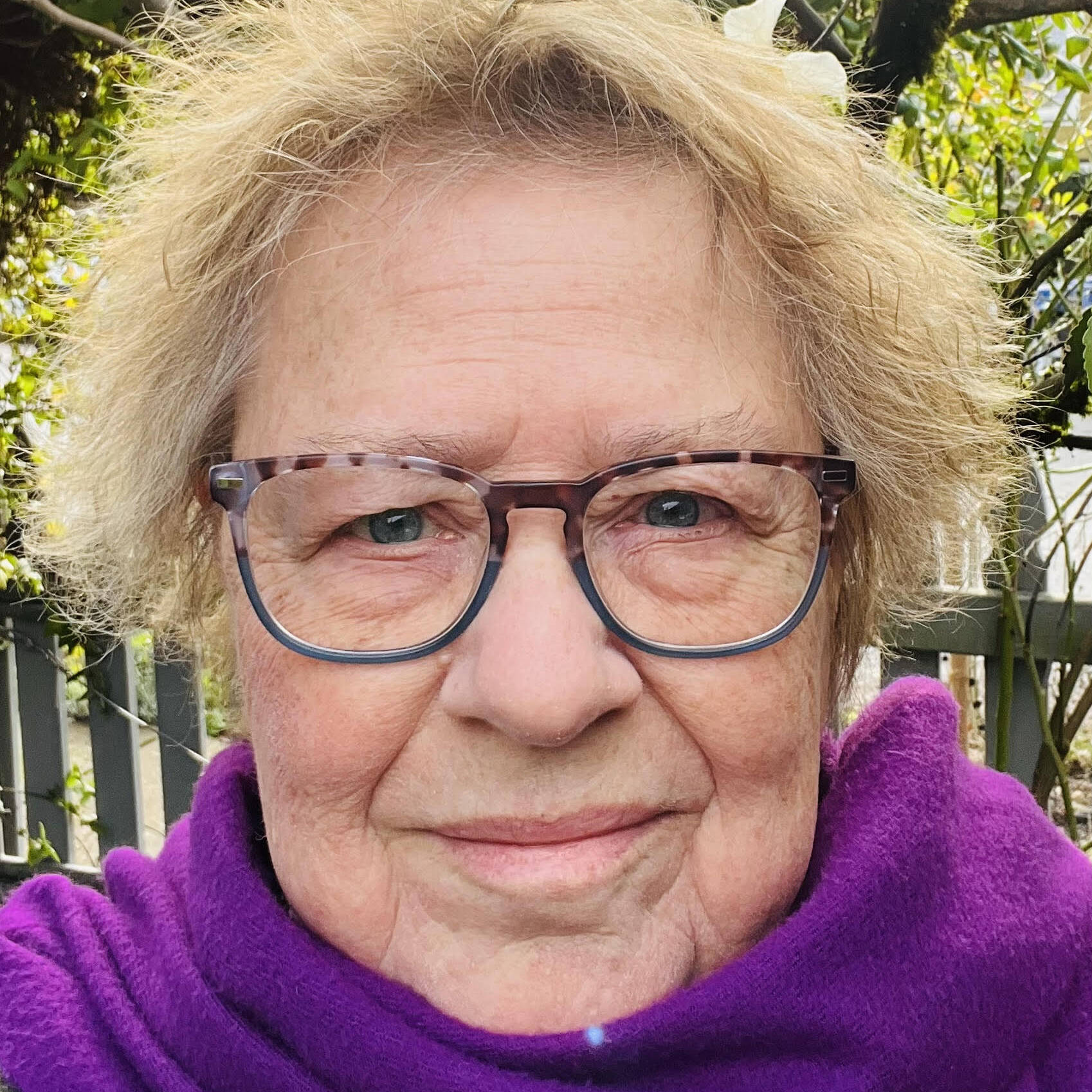
Elizabeth McLagan is a poet and co-founder of CALYX, one of the women who helped build the journal at a time when publishing was overwhelmingly male and resistant to change. Fifty years later, her reflections carry both clarity and grace: a belief in beauty as resistance, art as sustenance, and joy as a necessary practice.
In this conversation, McLagan looks back on CALYX’s beginnings, its flowering across decades, and the quiet persistence that has kept its song alive.
As long as we are here, we must sing.
Q1. You were there at the founding of CALYX. What was the cultural and political air like then, and what kind of responses came back when those first issues went out into the world?
Fifty years ago, I was just getting started as a writer, grasping toward an authentic expression, sending out poetry, and acutely aware that the audience consisted predominantly of male editors. I was rebelling against the seductive dance of writing to please, yet wondering what I had to say and who might listen.
To oversimplify, the cultural and political air was primarily male-driven. So we decided to work against that.
When we sent out those first issues, what crackled back was a rich mix of enthusiasm, joy, and resentment. And in our own small way, we felt empowered, whispering subversion from an unlikely corner of the world.
Q2. CALYX began as a collective, including Barbara Baldwin and Meredith Jenkins. What do you remember most vividly about working with them?
Barbara and I were both poets, and I really admired her. I remember her excitement in finding the name CALYX. After some initial hesitation (it can be hard to pronounce) it felt exactly right.
As someone who now tends an urban meadow, I’m constantly reminded how much people need and appreciate beauty. The flower became a central metaphor for the journal, and in these times, we need it more than ever.
I’m not sure who first insisted that the journal also publish visual art, but Meredith Jenkins had an extraordinary eye for it. Art has always been essential to CALYX for me.
I also vividly remember an editorial meeting when Barbara passed around poems by an unknown writer (at least unknown to me) named Sharon Olds. One of those aha! moments you never forget.
This work of resilience is ongoing and absolutely necessary.
Q3. When you look at CALYX today, its reach, its politics, its voice, does it feel like an evolution of what you helped build?
I doubt I could have predicted how both the world and CALYX would change over fifty years. But on the level of individual poems, I see a consistent excellence in the work as the range of experience has broadened and deepened. Every connection I’ve discovered or rediscovered through the journal makes me very happy, and a lot less lonely.
This work of resilience is ongoing and absolutely necessary, especially as we face so much uncertainty and pain. Whether we are moving forward or being forced backward, we must temper judgment with the practice of joy.
Q4. If you had to name one thing this moment in history demands from feminist publishing, what would it be?
We are inundated with bad news. But underneath it, and beside it, and above it, good news is whispering just as relentlessly. As long as we are here, we must sing.
Q5. Is there anything else you’d like to add?
My poem “In the Late Life” is about aging, the life of the mind, endless possibility, and openness to all kinds of experience. Although we always hope that something permanent will come from our artistic practice, aspiration itself feeds the spirit.
I am honored to be part of this sister network, this ongoing library of words and images that honor and nurture our creative life.
Anaïs Godard is a Franco-American writer based in Los Angeles, CA, and former television producer who spent a decade interviewing celebrities. She is the 2025 Mike Resnick Memorial Award winner and a Letter Review Prize recipient. Her work has been published in McSweeney’s, Hobart, Fractured Lit, and elsewhere.