Fifty Years of Herstory
An Interview with Jean Hegland by Anaïs Godard
Get the 50th anniversary issue of CALYX Journal here
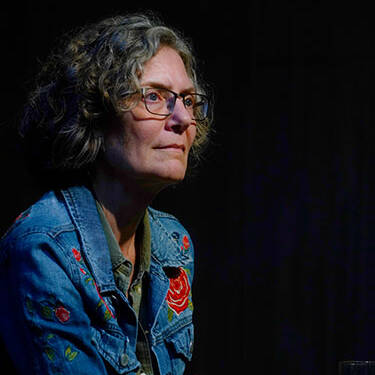
Jean Hegland is the author of Into the Forest, one of the most enduring and unlikely success stories in CALYX’s history. First published by the press in the 1996 after being rejected by dozens of publishers, the novel went on to become an international phenomenon, translated into sixteen languages, adapted for film and stage, and taught in classrooms around the world.
In this conversation, Hegland reflects on what it means when a feminist press takes a risk before the market does, on editorial faith as a form of courage, and on why the political, ecological, and feminist questions at the heart of her work feel more urgent now than ever.
CALYX helped me trust that the stories I wanted to tell might actually matter.
Q1. Into the Forest has had a remarkable afterlife: international acclaim, adaptations, and now a sequel. What did it mean to have CALYX believe in that manuscript before the rest of the world caught up?
When I finished Into the Forest in the mid-1990s, I hoped to find an agent, but none were interested. Every response said the same thing: the book was impossible to sell. The protagonists were teenagers, but the novel was too dark for young adult fiction. It was set in the future but didn’t belong on the science-fiction shelf (no spaceships, no aliens).
I began submitting to small presses willing to consider unagented work. When CALYX accepted the manuscript, it had been rejected by more than two dozen publishers. My first reaction was relief that the book would be published at all. That quickly turned into gratitude when I realized how fortunate I was to be working with a nonprofit feminist press of such integrity and vision.
Working with CALYX remains one of the very best publishing experiences of my life. I’m always grateful when editors take my work as seriously as I do, but at CALYX, I had an entire team of editors who understood what the book wanted to be and helped me get there. At one point, I had a conference call with Margarita Donnelly, Beverly McFarland, and Terri Mae Rutledge, all of whom urged me to reconsider a plot twist they felt didn’t serve the story. I resisted, then took a long walk in the forest, realized they were right, and found a solution that satisfied us all.
CALYX’s belief in the book went far beyond editing. They invested in beautiful design, cover art, and promotion, and they did so at real risk. It may be apocryphal, but my understanding is that CALYX was close to bankruptcy when Into the Forest was published. Even so, they took out a loan to hire an external publicist and send me on a reading tour, one largely built around my family’s summer road trip. (At one stop in Missoula, Montana, I spoke to an audience of one.)
A few months later, Margarita called to tell me that an independent bookseller in Albuquerque had brought the novel to the attention of a New York publisher and that a bidding war was underway among New York publishing houses. My three young kids were bouncing around the living room while she shared that astonishing news. I began tossing chocolate chips at them in a desperate attempt to sound professional. For years afterward, whenever the phone rang, they’d ask, with hopeful eyes, “Is this an important call?”
That call led to CALYX selling US rights to Bantam Books. Since then, Into the Forest has appeared in sixteen translations, a Canadian feature film starring Elliot Page and Evan Rachel Wood, a French graphic novel, and even an opera. The French edition alone has sold over 350,000 copies.
I truly believe that without CALYX’s vision and courage, none of that would have happened. I will always be proud and grateful to be a CALYX author.
Every agent told me the book was impossible to sell. CALYX didn’t ask where it fit, they asked what it wanted to be.
Q2. There’s something almost mythic about a small feminist press taking a big risk on a book that becomes iconic. Did that early vote of confidence shape the book’s trajectory, or your own?
Absolutely. As an ardent feminist, it mattered deeply to me that Into the Forest was published by a press whose values aligned with my own, and one that had already published so many writers I admired. CALYX helped me see myself as a “real” writer and trust that the stories I felt compelled to tell might actually matter to the people I most wanted to reach.
Q3. Now that you’ve returned to the world of Into the Forest, what threads from CALYX’s original vision feel newly relevant?
After Into the Forest, my next novel, Windfalls, was about contemporary motherhood. Then I wrote Still Time, a story about a Shakespeare scholar contending with Alzheimer’s disease while he tries to reconnect with an estranged daughter. Despite the diverse subject matter and style of those books I believe they all share the same underlying DNA. When I realized I was still thinking about the characters of Into the Forest decades later, I felt drawn to revisit them and the forest I’d left behind.
As I returned to that world, I saw how much my beliefs had only intensified: my commitment to representing women’s diverse experiences, my conviction that everything we are comes from nature, and my fears about the fragility of human civilization.
Climate change, gender, power, and collapse felt impossible to ignore this time. Especially when our country is being led by a sexist, racist president. Revisiting Nell and Eva required me to reckon with language, with expectations, and with ecological realities that weren’t nearly as visible twenty-five years ago. It made a multi-pronged societal unraveling feel not speculative, but plausible.
The French edition of this sequel, Le temps d’après, was published in January 2025. The US edition is currently seeking the right home, and I’m now, once again, in what I call “the infinite middle” of a new novel.
Q4. If you had to name one thing this moment in history demands from feminist publishing, what would it be?
When CALYX was founded, many believed feminist presses would only be necessary for a decade or so, that equality was just around the corner. Fifty years later, it’s painfully clear how deeply entrenched the patriarchy remains. Feminist presses are still urgently needed to support human rights and amplify voices, especially women-identified voices, that are too often marginalized or silenced.
Q5. Is there anything else you’d like to add?
One of my proudest CALYX connections is that my daughter, Tessa Fisher, was an intern at the press in 2006. She learned a great deal and carries fond memories of Margarita and Beverly. Elizabeth Wales was the agent representing CALYX when the US rights to Into the Forest were sold to Bantam. She and I ended up working together for the next quarter of a century, and I continue to be grateful for all Elizabeth did for me as well as for CALYX during that time.
Anaïs Godard is a Franco-American writer based in Los Angeles, CA, and former television producer who spent a decade interviewing celebrities. She is the 2025 Mike Resnick Memorial Award winner and a Letter Review Prize recipient. Her work has been published in McSweeney’s, Hobart, Fractured Lit, and elsewhere.