Fifty Years of Herstory
An Interview with Emily Elbom by Anaïs Godard
Get the 50th anniversary issue of CALYX Journal here
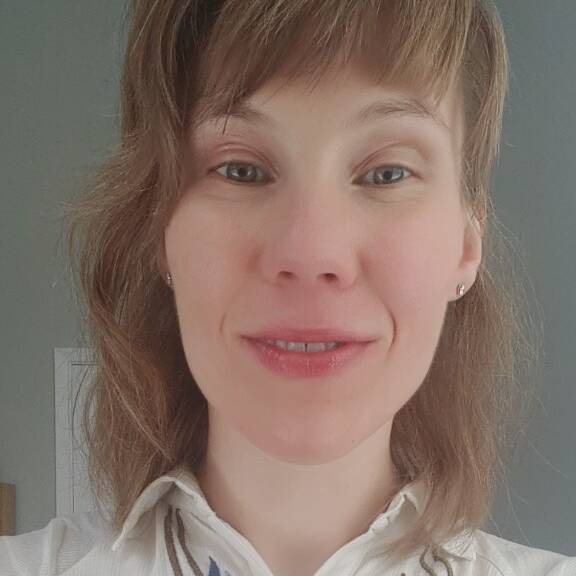
Emily Elbom knows the slush pile not as a myth but as a living ecosystem. As Poetry Editorial Coordinator at CALYX, she has spent more than a decade reading, rereading, debating, and advocating for work that surprises, unsettles, and endures. Her perspective sits at the intersection of care and rigor: deeply aware of the vulnerability of submission, and equally committed to collective responsibility.
In this conversation, Elbom reflects on what a CALYX “yes” really means, why collaborative editing matters, and how emotional voltage is less about trend or polish than about work that could only have been written by one particular writer, in one particular voice.
We feel a deep responsibility toward the work we’re entrusted to read.
Q1. You’ve spent over a decade excavating the slush pile. What patterns, obsessions, risks, or avoidances do you see in contemporary feminist writing? And what does a CALYX “yes” actually look like?
There isn’t one way to describe a CALYX “yes.” There’s no formula, and I find that exciting. We say yes for many different reasons: a piece might move everyone in the room, feel urgent or timely, raise complicated questions, or offer language that’s extraordinarily beautiful or original. Sometimes it’s simply a topic or perspective we haven’t encountered before.
What matters is resonance, with CALYX’s values, with the collective, and with our readers. But how that resonance shows up is never quite the same. We feel a deep responsibility toward the work we’re entrusted with. Pieces are read by multiple people, discussed at length, and held in mind over time.
Submitting is a vulnerable process. As a writer myself, I know the pressure to please publications, to anticipate what an editor might want, or to publish simply because you feel you should. That pressure can lead writers to avoid risk in topic or in craft. Obviously it’s important to know a journal before submitting, but just because an issue leans toward a certain theme doesn’t mean we’re only looking for that.
We love being surprised. We love work that opens new conversations, challenges conventions, or moves in directions we didn’t expect. We love brave work.
As for patterns: there are character tropes and topics we see often. Eve, Persephone, familiar mythic figures. It’s hard to surprise us there, but we love it when it happens. Interestingly, we see far less work about women’s professional lives or the overlap between personal and professional identity. We read a lot of beautiful work about mothering, for example, but less about being both a mother and a professional, or caring for an aging parent while living an independent life. Those spaces feel underwritten, maybe because writers are thinking about them separately or writing about them separately.
The pieces that rise are the ones that feel like they could only have been written by that writer.
Q2. CALYX uses a collaborative, feminist selection approach. In practice, how does that shape what gets chosen? How does it change conversations around craft, politics, and risk?
The collective model means there is no single taste, no dominant voice, no singular point of view. I find this wonderful. We bring different life experiences, aesthetics, and political perspectives into the room. We’re not trying to publish one kind of work; we’re committed to publishing a spectrum.
We don’t need full agreement to select a piece. What matters is that everyone in the collective can stand behind it—even if it isn’t personally their favorite. We don’t have to agree on craft or interpretation, but we do affirm collectively that the piece belongs in CALYX and will resonate with our readers.
That process can be challenging. There are difficult conversations and tense moments. But what distinguishes our approach is that we listen through disagreement.
Q3. That feels deeply feminist. You’ve worked in both poetry and prose here. What connects the pieces that rise to the top, regardless of genre? Is there a certain emotional voltage you look for?
For me, and this is again subjective, the pieces that rise are the ones that I feel could only have been written by that writer. There’s something in the voice, the craft, the way language is used that astounds me, delights me, and stays with me long after I’ve finished reading.
I like work that I don’t always fully understand has something in it that makes me reread it multiple times. That doesn’t mean the work has to be experimental, but it often engages deeply with language, form, or genre.
A piece I still think about is Megan Paslawski’s “A Raccoon Bites Jen” (Vol. 33:3), a story told in reverse chronology about a woman’s partner who refuses a rabies shot after being bitten. It’s quiet and devastating, intimate and political at the same time, touching on relationships, bodily autonomy, and belief in science. It’s one of those pieces where I felt only that writer could have written it that way. That, for me, is the emotional voltage: specificity, risk, and a voice that lingers.
Q4. If you had to name one thing this moment in history demands from feminist publishing, what would it be?
Community. All kinds of brave, powerful, and transformative things come out of community.
Anaïs Godard is a Franco-American writer based in Los Angeles, CA, and former television producer who spent a decade interviewing celebrities. She is the 2025 Mike Resnick Memorial Award winner and a Letter Review Prize recipient. Her work has been published in McSweeney’s, Hobart, Fractured Lit, and elsewhere.