
AN EXODUS OF SPARKS, Allisa Cherry. Wheelbarrow Books, Michigan State University Press, 1405 South Harrison Road, Suite 25, East Lansing, MI 48823, 2025, 82 pages, $15.95 paper, www.msupress.org.
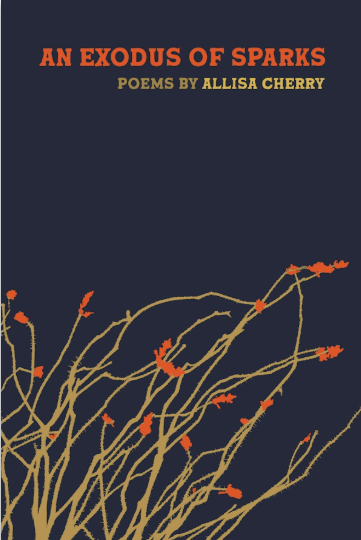
Allisa Cherry’s debut collection, An Exodus of Sparks, offers readers a riveting account of faith, loss, and fierce familial love. Using vivid and precise detail, clear syntax, and a diction both biblical and contemporary, Cherry achieves an emotional clarity that sizzles on the page and cuts to the heart.
As a prelude to the book’s three sections, the poem “Salt River” sets the tone for Cherry’s exploration of identity and upbringing in the desert Southwest, where people were exposed to radiation and fallout due to extensive nuclear testing. The poem begins: I am a stranger here. Next we learn that the speaker’s father is dead, and [h]e is the canyon // I carry inside me. / A cranium full of relentless light…. In the last section of the poem, Cherry writes:
How will I praise him in this desolate land?
Where will I go
now that I’ve dusted my shoes
of the irradiated soil that took him?
In the exquisite poems that follow, Cherry’s speaker—as a daughter of downwinders, a sister, and a mother—grapples with these questions and confronts grief and trauma head-on.
Throughout this collection, light is a recurring image that serves to both sharpen the focus and soften the harsh edges of a lived experience. In Section I, we encounter a fight on basement steps between the speaker’s father and brother in “Without Any Warning”: where a bare bulb lit / my brother’s ascent / his fists flying, his mouth / spitting sparks as he rose. And the next morning, when father and son reconcile, a light poured // through a fist-size hole in the drywall / and illuminated our mother….
The imagery of light is also on full display in “Fatherland.” In this poem, the speaker is driving toward the place of her upbringing: I do not love you, / Arizona, and I said / I would never come home. Hours from the border, the speaker imagines her sister’s eyes are two basins of water. But it is only a mirage that
ripple[s] toward her
like a highway
at its vanishing point. Where a ship might emerge from a seam
between this life and the other.
A ship captained by our dead father
conveying his kin. All made of silver compounds.
Overexposed and shimmering. Inexplicable on your skyline.
This lyrical moment is composed entirely of light, immersing the speaker in a surreal beauty and profound loss that defies understanding. And Cherry pulls us into this unsettling moment right along with her.
My father was so small when you began to powder his milk teeth and bones with your radiation.
In the last poem in Section I, “Sage: A Note to Self,” Cherry prepares us for the crown of sonnets in Section II: This is how I will arrive at salvation. / I’ll pull Moses / from the deserts of Judea, / place him in Apache County. The voice in these sonnets is a kind of divine feminine, speaking intimately to Moses. In “The Appropriation of the Body of Moses,” the voice says:
There are no clouds
over the tabernacle of this desert. When the setting sun
strikes the flint of the canyon rim, the sparks
ignite us. And we go up in flames like a bush.
The divine feminine and Moses seemingly cannot be separated. In the next poem, “The Interment of the Body of Moses,” we find that a part of each of them remains in this desert:
The final ember escapes from the bramble
but the bramble remains, burnt and twisted
on the canyon’s rim.
Then we reach the sonnet’s volta, in which she acknowledges her struggle to become herself apart from the patriarchal religion of her childhood:
Sweet faith, I don’t know who I am without you.
Unrecognizable, without faith or family.
The imagery of light is very much present in the title poem “An Exodus of Sparks,” which closes the collection. The first section of the poem addresses America directly in a scathing indictment that is personal for the speaker: My father / was so small when you began to powder / his milk teeth and bones with your radiation. Yet, even as he lay dying, the speaker’s father believed in his country: When he died / his curled hand looked like it still / clutched at your garment’s bright hem. In one devastating blow, Cherry lets us feel the anguish of that moment.
In the last section of the poem, the speaker imagines that her dead father will appear in a doorway, his new hair / transparent against his gray-green skin / the only part of him undiminished—the quantum / of light in his eyes.
With this deeply affecting collection, Cherry proves to be a poet brave enough to be vulnerable. And we are the beneficiaries of this journey she has undertaken to transcend grief and trauma. Cherry has given us a gift that readers will want to experience for themselves.
Eileen Pettycrew’s poems have been published in New Ohio Review, CALYX Journal, Cave Wall, ONE ART, SWWIM Every Day, The Ekphrastic Review, MacQueen’s Quinterly, Blue Heron Review, and elsewhere. In 2022 she was one of two runners-up for the Prime Number Magazine Award for Poetry, a finalist for the New Letters Award for Poetry, and a Pushcart Prize nominee. Eileen holds a Master of Fine Arts in Writing from Pacific University and lives in Portland, Oregon.