
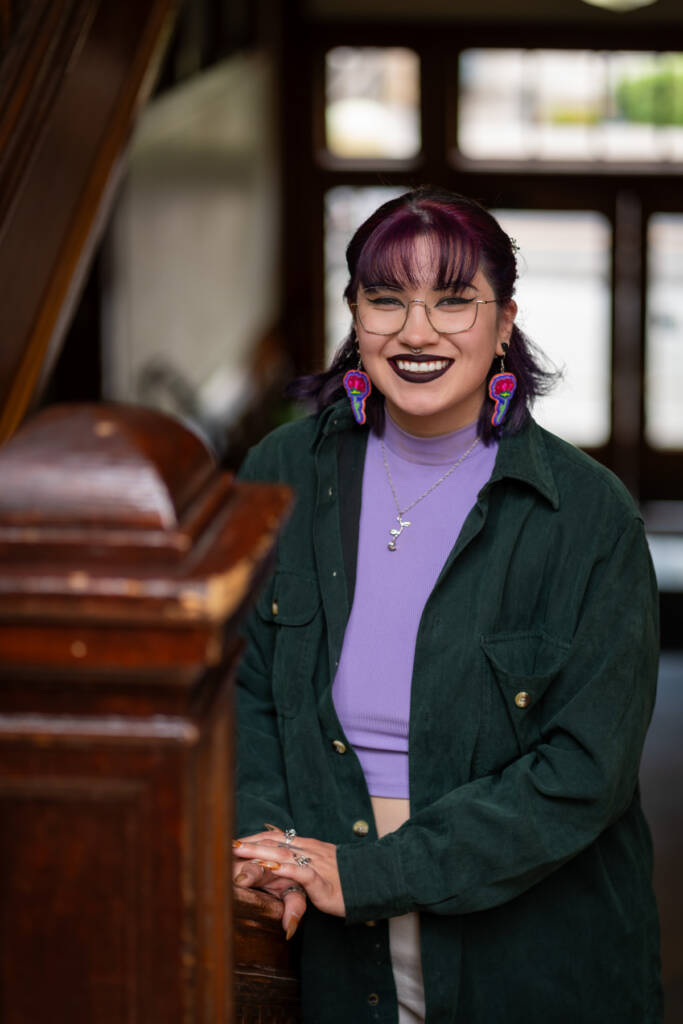
Photo credit: OSU CLA photographer, Blake Brown.
Balancing academic deadlines, work responsibilities, and a personal life is no small feat for a college student. Yet during her undergraduate years at Oregon State University, Tayah Kohler not only kept pace—she distinguished herself. Through a funded internship with CALYX Press, a historic feminist publishing house based in Corvallis, Kohler embarked on a research journey that would earn her a place at the 2025 Undergraduate Humanities Research Conference.
Her internship, supported by the Spokane Tribal Council, provided more than professional experience—it sparked a rigorous inquiry into the politics of identity. Kohler’s resulting paper, The Irony of “Being” Indian, explores the complications that arise when individuals assert Indigenous identity without verifiable connection to Native communities. She focused on the case of Gail Tremblay, a writer and artist who was long affiliated with CALYX and whose work, including Indian Singing in 20th Century America (1990), engages with themes of Native representation despite her lack of tribal enrollment or proven ancestry.
Kohler’s paper examines how self-proclaimed identities, when disconnected from communal ties or cultural stewardship, can unintentionally reinforce the very structures of appropriation they claim to resist. Tremblay’s body of work—especially her critiques of Native stereotypes in film—serves as a paradoxical example of this dynamic.
Through detailed research into Tremblay’s public narrative, use of language, and biographical claims, Kohler presents a compelling argument about the risks of race-shifting and the misuse of platforms intended for authentic Indigenous perspectives. Her analysis points to a broader need for institutions to critically assess how identity is validated and how those decisions impact tribal autonomy and cultural continuity.
Ultimately, Kohler calls for stronger standards of accountability in academic and artistic spaces, advocating for policies and practices that prioritize the voices of those grounded in lived experience and recognized by their communities. Her work adds to the ongoing conversation around cultural responsibility, representation, and the ethics of identity in contemporary society.
Learn more about Kohler’s internship and research through Oregon State University’s College of Liberal Arts.
“Appropriation can hide in plain sight, claiming activism by critiquing misrepresentation, while at the same time performing it.”
This slideshow features art from Colville Tribal artists, Arianna Seymour and Beatrice Seymour.