
Fifty Years of Herstory
An Interview with Sibyl James by Anaïs Godard
Get the 50th anniversary issue of CALYX Journal here
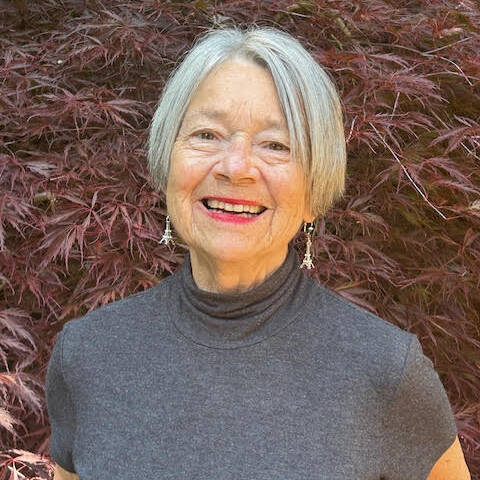
Sibyl James has been writing across genres—and across eras—long enough to remember when feminist publishing meant unapologetically trying to change the world. She was there in the heady early days, and she’s still here now.
CALYX published her first book, one of the press’s earliest, and remained a literary home for her work. In this conversation, James reflects on what has changed and what has quietly slipped away in feminist publishing, on moral clarity as a literary responsibility, and on what it means, at seventy-nine, to return to a journal that still knows how to read long, complex poems.
If there is a throughline, it’s curiosity.
Q1. Your work spans poetry, translation, memoir, and children’s literature. What connects those genres for you, and how did CALYX support those shifts?
If there is a throughline, it’s curiosity. CALYX published my first book, which was an experimental translation of a sixteenth-century French poet—so I was already poking around in multiple directions. After publishing some of that work in the journal, they suggested I turn it into a full book, which became one of their first book publications.
They also supported my foreign travels, publishing my first nonfiction book, a memoir of the year I taught in China. And when I ventured into children’s stories, they published those too, even though it was a new genre for the press. CALYX was consistently willing to follow the work where it wanted to go.
Q2. You’ve published across many literary decades. What changes in feminist publishing have felt meaningful to you, and where do you see old patterns returning?
I have to admit I haven’t kept up closely with recent feminist publishing, at least not in the way I was deeply involved during the heady days of the 1970s and ’80s. It feels like there’s less focus now on the early political, “change the world” motivation and more emphasis on the assertion of specific identities.
That said, it’s encouraging to see pioneers like CALYX and Red Hen still out there, still publishing, still holding space.
Feminist publishing must take a loud and active stand.
Q3. As someone with a long history here—and new work in the anniversary issue—what does it feel like to return to CALYX at this milestone moment?
At seventy-nine, I feel a bit like an old lady from the warrior days, happy to see new people carrying the work forward. I’m pleased to have a long, complex poem in a journal where I know readers will understand it.
Q4. If you had to name one thing this moment in history demands from feminist publishing, what would it be?
To take a loud and active stand against a society where people silently allow genocide and the cruel treatment of immigrants and the poor.
Anaïs Godard is a Franco-American writer based in Los Angeles, CA, and former television producer who spent a decade interviewing celebrities. She is the 2025 Mike Resnick Memorial Award winner and a Letter Review Prize recipient. Her work has been published in McSweeney’s, Hobart, Fractured Lit, and elsewhere.