
AFTER NAMING THE ANIMALS, Barbara Ungar. The Word Works, PO Box 42164, Washington D.C., 20015, 2024, 88 pages, $19.99 paper, www.wordworksbooks.org.
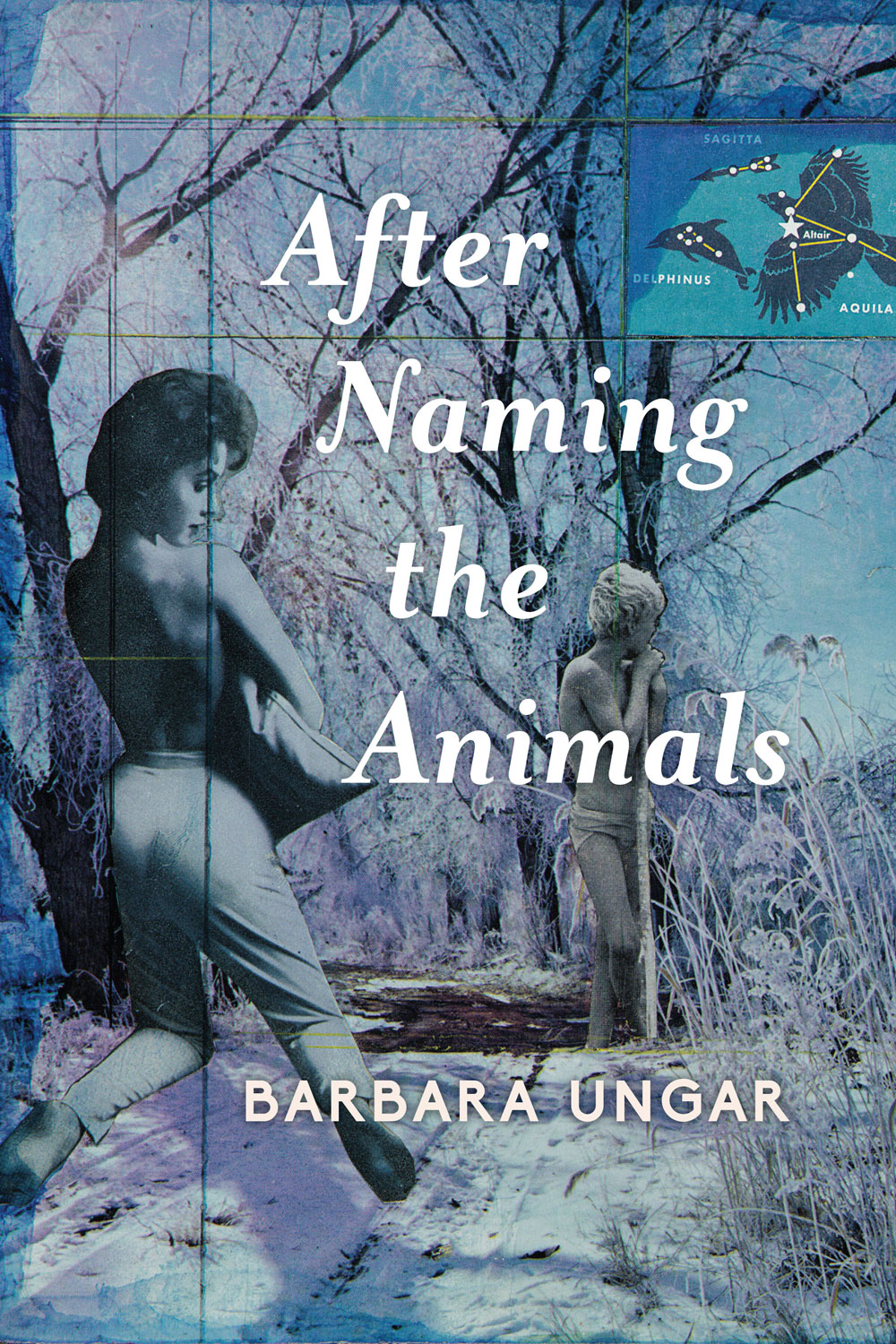
In the beginning, a Barbie doll tells us, there was no beginning. No time. No world. She is a Kabbalah Barbie, a fragile toy molded from plastic. Yet she speaks to humanity about Ein Sof—boundless nothingness—and the genesis of life. I pause to mull the paradox and mystery. Barbara Ungar’s sixth book of poetry, After Naming the Animals, weaves ecology, allegory, spirituality, and science into a plea for a dying planet. The poems are profound and accessible, dark and witty. Even as apocalypse looms, they radiate awe.
As the title suggests, the heart of this collection lies in the power of naming. Every living creature is spoken into existence and will eventually return to the Nameless. The Kabbalah Barbie proem introduces three sections that elaborate on the entwined relationship between language and creation.
In Section I, Shattered Vessels, the poems focus on brokenness and denial. “Kintsugi for Aunt Vera” asks whether the ancient Japanese art of mending can repair a treasured cup that looks like heaven. Significantly, the cup has broken into three pieces. Perhaps it can be patched together, even improved. However, the cup, like the aunt who molded heavenly things from clay, cannot be kept. Is there anything in this world we truly possess?
No one names girls Barbara anymore.
Through measured tercets, “Weight” compares human population to the total mass of life on Earth as described by the National Academy of Sciences. Originally published in Scientific American, the assay reads like a haunting incantation of lives we give little thought to––bacteria, worms, trees. The tragic irony is that humans, although they represent a mere hundredth / of a hundredth of the living, destroy so much, and do so with callous obliviousness.
Our heads—our ability to think and reason—make us human. Unlike sea slugs, we lose our lives if we lose our heads. Nevertheless, we are all too eager to push reason aside, to pretend we don’t know obvious realities. “My Head and I” moves from a father’s dementia to a dream about a head that is literally removed—hung like a pocketbook from a hook in a bathroom stall—and then restored, but crookedly. The narrator secures the head to her neck with a hat pin and hopes no one notices.
However, the poems in this collection of ecopoetry do notice. Moreover, the poems describe and celebrate. Section II, Call Me Eve, opens with Chava, the Hebrew name for the first woman and the giver of life. Chava names the animals, and these names, spoken in many languages, all mean “goodbye.” The seventeen poems that follow describe creatures that are shockingly beautiful in their strangeness: bats small as bumblebees, owls the size of bluebirds, ocean slugs who wear feathery cerata like headdresses for Cher. Most of these are drawn from “EDGE” lists of Evolutionarily Distinct & Globally Endangered species.
Also included in the exotic menagerie is “Santa Barbara,” a humorous riff on the poet’s first name. Barbara is etymologically related to barbarian, barber, barbiturates, a town in California, and a parade of mythical figures—a Santerían god of fire and lightning, a Rapunzel-like maiden who first loses her breasts and then her head. In the United States, Barbara becomes the omnipresent plastic doll—three Barbies sold every second. But names are as ethereal as the named, and no one names girls Barbara anymore. The poet who wears that name senses that she, too, has become endangered.
Recent years have brought staggering losses. “22 Extinctions in 2021” is an ode to exotic creatures with lyrical names like stirrupshell, tubercled-blossom, and nunupu’u. The musicality and rush of awe remind me of “Pied Beauty” by Gerard Manley Hopkins. But this poem is more than a hymn of praise. It’s a Kaddish for lost songs and ingenious lifeforms. The extinct species were our little sisters and brothers / whether we ever met or called their names.
So there’s no hope? No magic kintsugi for the broken world? Section III, Sacred Shards, offers “Resolutions for 2024.” Perhaps lives can be saved if we become a bit less human— Learn the language of animals, Taste like a peach, and Sweep the footprints off the moon.
The resolutions seem impossible, but in this section an aura of mysticism blends with scientific precision and deep reverence. “Star Apple” lauds the fruit that fell for Newton / as for Eve. Shape-shifting imagery moves from apple into the realm of astrophysics. Slice the apple and you find a star formation of seeds so dark they suggest black holes—impenetrable cosmic bodies at the center of each galaxy, or the unknowable Ein Sof referenced at the opening to the collection. From this dark energy, Kabbalah’s archetypal tree of life might bloom. Both science and faith tell us that there is wonder in the void:
as the tongue loves
the apple does the night
sky love the star
Affection mingles with frustration in several poems about college students and a teenaged son who believe they will never age. Feeling the pull of gravity, the world-weary speaker reflects on empty nests and vanishing bones. But what is gravity? A space-time curve? And do space and time exist on the quantum level?
The poems that follow these ruminations move from resignation to exultation. Even during the end days with thirteen kinds of crazy, some birds return. A rehabbed owl reclaims its realm of sky. Reflected in a dark window, a woodblock print of a geisha seems to float like a hologram through the storm outside. In the penultimate poem, “Dream Voice,” a detached narrator, you, looks in a mirror and sees her human body as a translucent form, pulsing like a jellyfish. She has become shining and wondrous, at one with the Nameless.
With a nod toward Kabbalah Barbie, the closing poem reminds us that all earthly things return to the Nameless. “Thought Cloud” lists things that clouds are not— not cotton batting, not charging dragons, not harbingers or symbols, and, comically, not shaped like a penis, // or not for long anyway. Rather, clouds are our a single stream of tears recycled / and reincarnated fields of snow. Like Aunt Vera’s perfect blue bowl, clouds can’t be kept. They are not translatable. // They can not stay.
Again, I set the book down and take a deep breath. They can not stay. Nothing can stay. But wait—why can not instead of the standard spelling, cannot? Is the not set apart for emphasis?Or is the not optional? They CAN not stay. I seize on the narrow space, imagine a glimmer of light through the opening—an alternate possibility. Time to save the planet! I’m probably indulging in magical thinking, but After Naming the Animals is a magical collection. Creation and extinction intertwine: the miracle of life springs from the endless, omnipresent Ein Sof through the mysterious power of words.
Jackie Craven is the author of WHISH, winner of the 2024 poetry award at Press 53, and other collections. She earned her Doctor of Arts in writing from the University of Albany, New York. Find her at JackieCraven.com.