
Altered: Stories We Found in Our Closets, ed. Monique de Varennes, Kathryn Hagen, Tinker Lindsay, Emilie R. Small, and Barbara Sweeney. Self-published, 200 pages, $15.99 paper.
Submit your story here: http://altered-stories.com/
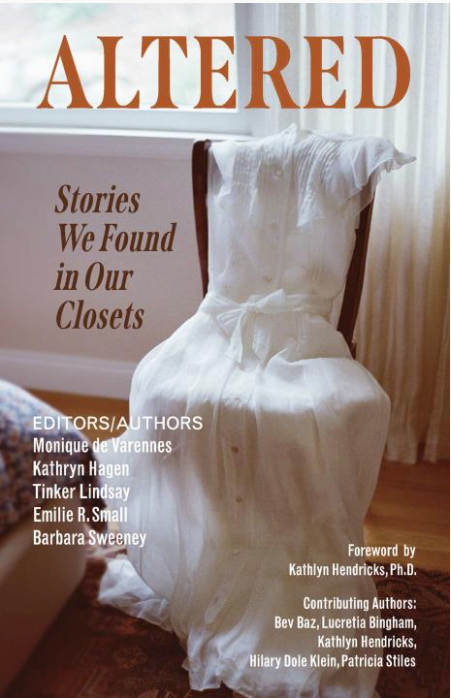
Do fashion choices really matter? In the eternal human quest for meaning and value, where does adorning ourselves fit? So asks Kathlyn Hendricks in the foreword to Altered: Stories We Found in Our Closets, an anthology of essays and poems that examine the often complex ways in which clothing has impacted the writers’ lives.
Altered is a collaborative effort by the writers’ collective The Foothill Five—Kathryn Hagen, Monique de Varennes, Tinker Lindsay, Emilie R. Small, and Barbara Sweeney—all of whom serve as editors and contributors for the collection. Collectively, the answer to the first of the two questions posed in the forward is a resounding “Yes.” The answer to the second is far more nuanced, depending on the individual writer’s experience and what she’s adorned herself in. Throughout the collection, clothing serves as a symbol of one’s gender or economic status. It marks one as part of a community, or as an outsider. It also has the power to shape one’s sense of self, not always for the better but always in a way that invites further introspection.
I no longer wore a bra. My hair reached halfway down my back. I marched for peace, and owned a mantra, and wrote letters in longhand on my father’s legal pads to strange men in San Francisco.
Of course, where fashion is considered, the word “choices” doesn’t always apply. In the opening story, “Old Habits,” editor/contributor de Varennes reflects upon her time growing up in a Catholic boarding school run out of a convent, where she was made to wear a uniform of a navy blue bolero jacket… matching knee-length skirt, white blouse with the inevitable Peter Pan collar, navy knee socks, and heavy lace-up shoes. This uniform signals her immersion in the ritualistic world of the boarding school, where she is sent by religious relatives and where, she writes, I’d managed to wrench my soul into a shape that aligned with the convent. While an older de Varennes ultimately rejects religion, the narrative goes beyond exploring the loss of an imposed faith. Instead it turns sharply toward the adult narrator’s epiphany that the convent has stayed with her, in the form of a closet “filled… with a specific set of clothing: jeans, sneakers, and cotton knit shirts— a uniform, chosen unconsciously.
It’s this retrospective gaze, filled with unrealized-in-the-moment truths, where Altered is at its most impactful. The narrators’ individual histories offer time-capsule glimpses into the societal forces that shaped them. In her essay “Three Brides,” a retrospective into the author’s three marriages, Patricia Stiles explores how each of her three wedding dresses captures not her identity, but the essence of the decade: conventional and restrictive in the 1950s, loose and freewheeling in the 1960s, individualized and conservative in the 1990s. I can see that I’m a different person in all of them, Stiles reflects. What each dress reveals now, she concludes, is the incredible power each era exerts.
Garments also offer surprising opportunities for individual expression. In “Lost. Found” Tinker Lindsay’s narrator recalls returning home for summer before her sophomore year in college, only to find that she and her parents no longer knew what to do or how to be with each other. I no longer wore a bra. My hair reached halfway down my back. I marched for peace, and owned a mantra, and wrote letters in longhand on my father’s legal pads to strange men in San Francisco. Her break from her parents’ values is further embodied in the form of a worn cowboy jacket, purchased spontaneously in a second-hand store, and with which she embarks on a solo camping/hiking trip along the Boulder Lake Trail despite promising her mom she wouldn’t camp alone. Although the jacket doesn’t survive the excursion, it affords her the opportunity to be bold. Rugged. Defiant. In others words, I could be Not-me. It’s a lesson that’s stayed with her longer than the jacket.
Clothing frequently highlights the tensions that run across generations, often between parents and children. In “Meet the Beatles, or How a T-Shirt Saved My Life,” Bev Baz recounts how her parents relocated the family from Toledo, Ohio to California’s San Fernando Valley in 1962. The sudden move, coupled with the parents’ Depression-era ways, leave Baz and her sister, Sue, stuck with a wardrobe of Ohio wool skirts and sweaters and black-and-white saddle oxfords that no one at their new school wears. Thrift-minded and clueless parents are a frequent theme throughout the collection; Baz’s own parents seem oblivious to the bullying their awkward daughters endure, although the narrative voice never lets childhood trauma and light parental neglect disrupt her humorous and light-hearted tone. It’s a welcome surprise for a story that deals with such heavy subjects, and it’s a welcome relief when the girls finally gain social acceptance through the donning of the titular Beatles T-shirts—an unexpected gift from their mother.
For as much as clothing can signal the gap between generations, it can also serve as an equalizer, connecting the dots between then and now. A fishing vest has the power to bond a daughter with her fly-fishing father (Emilie R. Small, “The Fishing Vest”); a lawn dress found in an old bureau leads to the revelation of a grandmother’s affair (Tinker Lindsay’s “The Lawn Dress”); a grandmother’s years of struggle are crowned, in a beautiful turn of phrase by Barbara Sweeney, by the ownership of a professionally tailored, store-bought coat (“The Store-Bought Coat”).
Through these various essays, clothes take on a quality that is both time-specific and timeless. They speak to an individual’s choices but also to the expectations impressed upon her. They divide generations in their sensibilities while also possessing the ability to cycle back and unite. To cycle ourselves back to Hendrick’s opening questions, fashion choices do matter, although specific meaning is far more ambiguous. If there’s one meditation that this collection leaves us with, it’s this: there’s no set or singular metaphor to be found in the literal layers of clothing. Just when meaning is set, it quickly shifts, presenting both limits and possibilities often in the same story.
What remains certain, however, is that a garment’s ability to have lasting impact is quite profound—a message that’s as joyous to unwrap as the surprise gift of a Beatles T-shirt.
Robin Kish is a freelance writer based in Boston, MA. Prior to going freelance, she worked as a senior writer, assistant editor, and news writer for GO Magazine. Her short fiction has been published in Ploughshares, The Florida Review, and other literary journals. When not traveling the world, she can be found at home with her wife and kitties or working on her first novel.