
EVERYBODY WANTS TO KEEP THE MOON INSIDE THEM, Ellen Stone. Mayapple Press, 362 Chestnut Hill Road, Woodstock, NY 12498, 2025, 85 pages, $21.95 paper, www.mayapplepress.com.
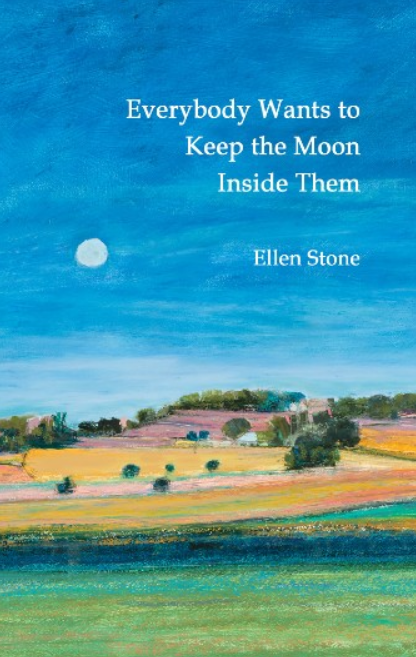
I thought I saw a needle flare in my grandmother’s hand. / Instead, it was a bookmark from her bible lying open there. Ellen Stone’s poem, “A wrist, a wren, a small knife” from her collection Everybody Wants to Keep the Moon Inside Them is composed of this technique of one image morphing into another, a metamorphosis of perception as the speaker tries to process their surroundings. And of course, one’s surroundings take up permanent residence as memories: [My mother] was a wrist, a wren in the morning grain, / the scaffolding, elaborate, around her starting to fall. This is the first poem in the book, and we are already under the spell of this magician of words.
Many of the poems in this collection explore the complexities of the mother-daughter relationship. The power of small gestures is captured in the poem “Homemaker”:
[…] No one knows how to preserve the world
you have created, but you, your large-veined hands
wringing the damp dish cloth over again.
In these lines, we experience loss, anxiety, grief, tedium, frustration… the thousand (not so) little emotions that fill an ordinary day.
The poem “Mother goes to the underworld” turns the myth of Demeter and Persephone upside-down; the mother is the one who is in the underworld // refusing the earth’s fruits while the speaker/daughter stays home, watching the world turn to metaphorical winter around her. There is a deeper level here, beyond the metaphors and myth.
A sudden disappearance of some sort, a physical and emotional retreat, occurs in many of these poems, always presented with empathy on the part of the speaker, always with the longing to understand this mother who is not like other mothers, this home that is unlike other homes. The poem “Depression as guest” offers a glimpse of this “other” family member, called simply “D.” D. who stands off to the side, planted there // like some odd tree. This poignant view of clinical depression as a “guest” at a family picnic, present even in the group photo taken at the event, both personifies the disease and puts some distance between the speaker and the presence of the disease, turning it into an “odd” family member that everyone sort of ignores and takes for granted. What a tour de force this poem is, showing the power of poetry to depict through imagery these psychological coping and defense mechanisms.
The word jackal too good, coyotes too monogamous for such human beasts.
Several poems in this collection depict the challenges of growing up female in this world. In “Girl of prey” the speaker learns—thanks to an encounter with a “wolf”—how to quickly metamorphose from “fawn” to “owl,” at last able to unfold my wings; spread my talons wide. “How to stay alive” is a more terrifying and ambiguous portrait of survival, in which he leaves / after he gets what / he wants, but / he does not kill me. In Stone’s poems, the rural landscape harbors as much danger and violence as any urban setting. “Hunting season” also uses images of predator/prey and hunter/hunted, perhaps as symbols of an adolescent’s awakening consciousness of the harsh realities of life.
It is important to not succumb to the fallacy that the narrator of each poem is the same speaker, but there is a sense of growth and progression in this collection. The speaker/daughter becomes a mother herself, which deepens her empathy for her own mother (who becomes a childlike figure requiring care). The alertness of the speaker of “Girl of prey” becomes the worry of the maternal figure in “Daughters leaving home in an age of aggression.” The word jackal / too good, coyotes too monogamous for such human beasts.
Stone’s poems also honor our literary maternal influences. One hears echoes of Emily Dickinson’s “I heard a Fly buzz—when I died” in the poem “House flies.” And the chilling “First married” is right up there with anything Sylvia Plath wrote about the nightmares inherent in everyday life.
Written with deep empathy and attention to craft, the poems in Ellen Stone’s Everybody Wants to Keep the Moon Inside Them explore the complexities of family and the individual’s search for identity.
Jean LeBlanc’s poetry and visual art have appeared in numerous journals and collections, most recently Terrible Terrain: Poems Inspired by the Life of Lavinia Dickinson (Shanti Arts Publishing, 2023). Her next collection, Our Family Tree and Other Myths (also from Shanti Arts Press), is scheduled for release in early 2026.