
LIBRE, Skye Jackson. Regalo Press, 1230 Avenue of the Americas, New York, NY 10020, 2025, 120 pages, $17.99 paper, https://regalopress.com.
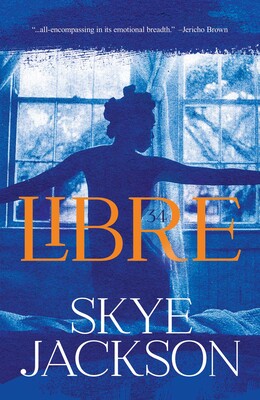
Skye Jackson invites readers into her debut collection with her award-winning poem, “can we touch your hair,” stumbling down the packed streets of New Orleans during a parade. The atmospheric chaos of the poem’s beginning, moments of parades, cold, and smashed, compounds when two white Southern women accost the speaker. An observer to this recounted interaction, the reader confronts barriers to the book’s title, Libre, or freedom.
Skye Jackson’s Libre features free-verse poems, prose poems, and other forms including list poems, odes, sonnets, and duplexes, and she ends her collection on a sonnet crown. The opening poem, “can we touch your hair,” where the speaker is told by a woman with an alabama drawl: gawd, you can do so much with it, was chosen by former US Poet Laureate Billy Collins for his Poetry 180 Program with the Library of Congress. Jackson illustrates how this parade-packed street exchange is more than microaggression when they write: then suddenly / just like my ancestors long ago, pulled apart // soft // by pale hands / from all directions.
As much as Libre is a collection about love, family, inheritance, and Jackson’s experiences as a Black woman, it is also an important collection about New Orleans that serves as a living testimony to the culture and history of the city. Jackson was born and raised in New Orleans, where she attended the New Orleans Center for Creative Arts (NOCCA) and later received an MFA in Poetry from The University of New Orleans Creative Writing Workshop. As the collection remembers details of the city’s past, readers experience the poem “i remember”:
it’s the sound of the last
mom & pop coffee shop
being torn down on the westbank
& a starbucks going up
in its place.
This poetic example illustrates the poem’s core: a city of antiquity, New Orleans, replaced with corporate emptiness and the subsequent erosion of culture. The poem “i remember” captures a wide span of experiences, references, and history. Jackson’s memory, their mother’s voice that echoes: i remember / when only black people / lived over here, and even the voice of the former mayor of New Orleans, Ray Nagin.
i remember when they wouldn’t let us in & now they’re pushing us out.
Amidst these voices, Lorraine Hansberry whispers to the poem’s speaker: i remember when they wouldn’t let us in / & now they’re pushing us out. Lorraine Hansberry (1930 – 1965) was the first African American female playwright to have her play, A Raisin in the Sun, performed on Broadway. As Hansberry whispers in a book titled Libre, it’s an additional layer of interest to know that she once worked for a pan-Africanist newspaper called Freedom.
Jackson closes “i remember” with: get ray nagin on the prison phone / let him know that this chocolate city / has officially melted. Louisianians remember the former mayor Nagin’s 2006 Martin Luther King, Jr., speech when he said he wanted to rebuild a “chocolate New Orleans,” despite his condemnation of the city and taking bribes, which later resulted in his conviction. Jackson’s seemingly short lines, already functioning to evoke themes of gentrification and corruption, conjure additional layers of memory and texture that bolster the poem’s unapologetic voice.
Jackson weaves together these various threads of memory and history into a seamless poem with powerful lines like gentrification is just / another word / for revenge. Direct and unwavering, Jackson’s work doesn’t shy away from the present or past. The various threads they weave into this poem illustrate the movement of the book as a whole—from micro to macro, personal to political, familial to generational.
These multifaceted layers span the entire debut collection. From referencing The Beatles to Elizabeth Bishop, Toi Derricotte, Josephine Baker, Charles Simic, Jericho Brown, and Claudia Rankine—Libre spans geographic and temporal boundaries. In the text, Jackson travels around New Orleans and beyond: to Berlin, Barcelona, and Paris to Vermont, Key West, and New York City.
Even Jackson’s New Orleans is not contained or limited. A tourist could follow her steps across the city from Esplanade Avenue to St. Charles Avenue, Marengo Street, Café Degas, Hotel St. Vincent, St. Claude, and into the Ninth Ward; from St. Bernard, Magazine Street, the Mississippi Bridge, Freret Street, Gallier Street, Uptown to R Bar, a mile to the Seventh Ward; from Peniston Street to the Westbank; from Mid-City to Burgundy Street; and from Canal Street to the riverbank.
In the poem “currency,” Jackson is in Paris and even the violence is cinematic. At the entrance to the train, Jackson is a witness to up-close brutality: men fighting each other, blood on their bodies.
i think, wow this is just like new orleans
and my boyfriend laughs & says, yeah except
there they’d all have guns & right now
the news would spread how
at least eight or more are dead.
Despite the boyfriend laughing the severity off or implying it could be worse, Jackson can’t escape violence, no matter where she goes. She still remembers New Orleans. While Paris may be more cinematic, the vulnerable, she notes, are still the vulnerable: people are the same everywhere / and I agree / because in paris & new orleans / violence packs its bags / but never takes a vacation.
The poem before “currency” finds Jackson comforting her lover in Paris and remembering an earlier museum visit. In the poem “to comfort you” the lover is thinking and dreaming of Mid-City and hoping the coming storm / back in new orleans won’t claim their bike, books, house, and art. The undercurrent of these poems is violence: violence of a storm or violence from people, a defenseless person or house at the whims of what they can’t control.
A few pages later, Jackson explores Musée D’Orsay in “under the shadow of a golden clock,” where she finds an exhibit devoted to black models of the past. / jeanne duval, the mistress of a poet and ira aldridge: / the first actual black person / to play othello onstage. In this museum and others, Jackson finds life in these still paintings. She breathes “sister” and “friend” to what she can see but others cannot. Later, in “the women in the wood,” she imagines Cézanne’s painting the large bathers remade. In Jackson’s version, the women can speak: remade / with my beautiful brown girlfriends / all of our bodies different shades / mouths actualized / full lips dripping with laughter.
Jackson sees the Black models of the past in shadow, and she imagines voice: the voice of Alexandre Dumas when he stood up after seeing Othello and, as Jackson writes in “under the shadow of a golden clock,” Dumas exclaimed i am a negro too / and i whisper the words to myself. Jackson’s voice joins the past.
In Jackson’s title poem, “libre,” which comes as the third-to-last poem in the collection, she writes after Claudia Rankine. Her multi-page prose poem begins in Key West during a writing residency where she meets a seventy-three-year-old white man who first takes a picture of her without her permission and then makes her an offer: you can go to the readings together and he will treat you to dinner. for some reason you can’t pinpoint, you feel uneasy but still say okay. At the dinner, the man talks about affirmative action and the Confederacy to a table of white people, a Black editor, and the speaker of the poem, the only other Black person. On the way to the reading, he forces a stop at a boat named Freedom once manned by a group of cubans escaping to america and makes the speaker take a photo in front of the boat.
In the picture, the speaker can’t force a smile, because the man has just said that the Black editor that they had dinner with is not “black black;” his diction is too good. These moments of discomfort captured by Jackson are more than discomfort—they represent the threat of violence. The atmosphere Jackson creates traps the reader alongside the speaker of the poem. In the final moment of “libre,” the man comments on the speaker’s smell, that you smell so good. Amidst this trapped discomfort, the speaker internally reveals that the perfume she is wearing is called Libre.
Jackson’s bold poetic voice, thoughtful pacing, and use of tone throws the reader into each poem, each moment alongside the speaker to feel like you’ve been hit in the stomach, as “libre” declares. Whether talking about a lover, an ex-lover, the deep love they had for their family dog, their now-passed brother, a museum visit, the expectations of editors who want only to publish Black pain, or a sugar daddy, Jackson’s voice is absolute. The final poem, “sugar daddy sonnet tiara,” finds Jackson in New York City settling into a quiet life, leaning into her own slow riot. Jackson’s riotous voice in Libre testifies to her explorations, sorrows, and joys alongside New Orleans’ history and hardships. Libre speaks back to the gentrification of New Orleans and honors the families who remain and those who have been forced to leave.
Emily M Goldsmith (they/them) is a queer Louisiana Creole poet and writer. They are an Instructor of English at Louisiana State University. Emily received their PhD from the University of Southern Mississippi. Their creative work can be found in Midway Journal, Moist Poetry Journal, Penn Review, Pithead Chapel, and elsewhere.