
MOTHER, DAUGHTER, AUGUR, Mary Simmons. June Road Press, PO Box 260 Berwyn, PA 19312, 2025, 99 pages, $16 paper, https://www.juneroadpress.com.
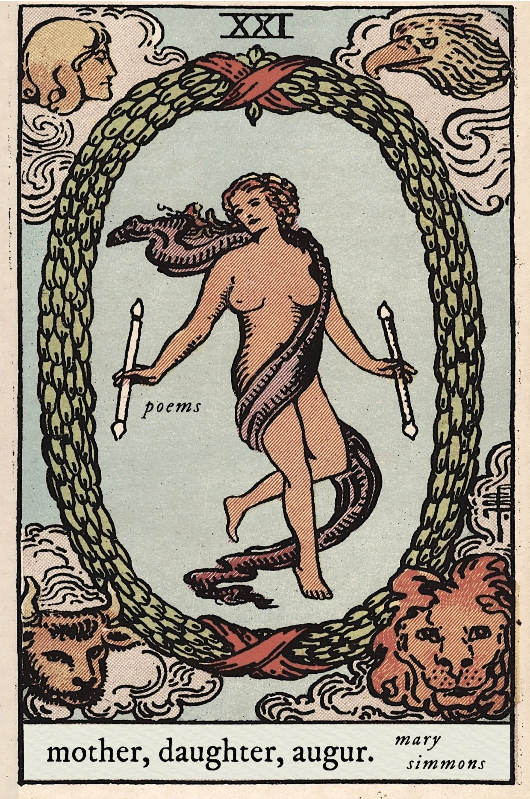
In her debut poetry collection, Mary Simmons weaves a lyric tapestry of mysticism, mythology, and herstory that revels in the arcane and natural worlds alike. Her book is peopled with women who tell fortunes with the help of insects, pile their bedrooms with corpses, and tell each other stories while we shake / last year’s storms from our wings (“Witches in Love”). Through lyric association and formal skill, these poems position queer love as a refuge against those storms, as a river that still knows / our names and wants us, calls us home.
The intimacy that forms the basis of these poems is never unaware of the weight of history, specifically the awareness of all the women who have lived and struggled in a patriarchal world. In “Victorian Hair Jewelry,” for instance, dead women arrive to provide the speaker with balms against the night and wreath my brow / in honeysuckle promises. Because as a woman, mourning begins / before life does. And because to wear this body each day is a taxidermy / of blunted knives, the speaker of these poems must know what it is / to shrink.
I will cradle this spider with my tongue until she thinks she’s a newborn again.
This love not only provides strength but also has a transformative effect on the speakers of these poems. In “Mother Tongue” the speaker yearns to return to nature: I soaked into her, // pieces of me burrowing into the knots / of trees. In “Odile,” the speaker experiences healing through a series of gruesome changes: Instead / of wings, hives sprout up and down my arms. Yet, despite the toothsome imagery, the speaker’s eyes churn with every lake / I’ve seen the stars in. Fingertips strike / flint against collarbone. We are soon given to understand this speaker not as a victim of change but as the architect of it: I want / singing to mean rapture, want throat to mean / it is not mercy if you can forgive yourself for it. At last, this transformation has given the speaker the power to re-order the meanings of words themselves.
The transformative power of love in Mother, Daughter, Augur isn’t relegated only to romance. In “Perhaps She’ll Die,” this love is directed at one of our most neglected creatures: A spider goes into diapause / under my tongue. I do not speak // all winter. This love is not charity but an act rooted in identification with the other: I will cradle this spider with my tongue // until she thinks she’s a newborn again. The speaker’s cooing reminds us that, at times, all we need is the magic of poetry to remind us that words won’t desert you, never, // never.
The world of Mother, Daughter, Augur is both familiar and drastically foreign. Its inhabitants beckon the reader deeper and deeper into this fantastical, dream-like maze where Below us, it rains and rains (“Odile”) and Every good ghost story begins with a girl / in the dark (“The Candle in the Mirror”). If you spend enough time in her world, Mary Simmons’ verses turn that feeling of unfamiliarity into what we need the most, until we are too happy to keep falling, drowning in this roundness.
Christopher McCormick (he/him) is a poet from the Midwest. His work appears in The Maine Review, The Midwest Review, Harpur Palate, and The Core Review, among other publications. He teaches in the English department at Ohio Northern University and reads poetry for Beaver Magazine.