
NAMING THE ROSES, Kim Noriega. Aim Higher Inc., 1693 State Route 28A, New York, NY 12491,2024,118 pages, $18 paper, https://aimhigher.org.
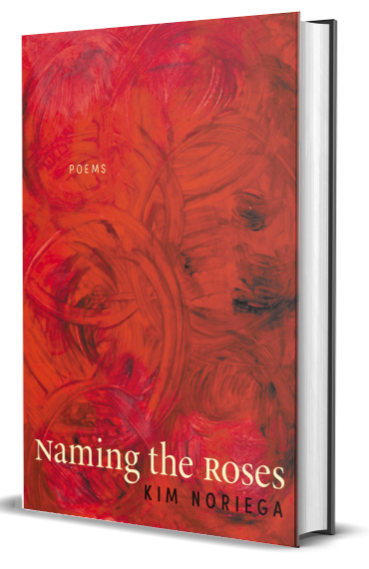
When poet Kim Noriega’s full-length collection Naming the Roses (AIM Higher, 2024) arrived in the mail, I saw only roses on the cherry-red cover featuring an intuitive painting by Sarah Luczaj. As I read the poems in this collection, I realized what an absolute privilege it is for me to hold a book with red circular smears on its cover and think only of a bouquet of roses, not blood.
The book starts with a command. The opening poem titled “Name Me” is narrated by a female speaker who repeatedly asserts her agency: Name me the girl / with the slate-blue eyes. A few lines later, the speaker’s tone shifts, listing pet names that she may not have chosen for herself, pet names that an abusive partner may have called her: Name me sugar lips. / Name me honey girl. / Name me sweet potato pie. In a line break that has the courage and intensity of a gymnast vaulting, the speaker continues, Name me the woman / with a black and blue eye. The anaphora in this poem becomes a mic drop as the speaker bears witness to her abuse:
Name me crushed larynx.
Name me fractured mandible.
Name me but I was high, baby;
it doesn’t count when you’re high.
The speaker’s naming of her abuse and cataloging of every broken toe, dislocated shoulder, and verbal abuse is exactly the relentless accountability we need now.
Because the moon shone on his shoulder, because his hand was on my thigh, because the scent of milk thistle was everywhere, and the light of day was gaining on me.
After reading “At the Edge of My Body,” it’s hard not to re-see the book’s red cover as the bloom / of my seared thigh— // a rubescent rosebud. The poems in Noriega’s collection bring the truth to light—the truth of many women who experience abuse from men. In the prose poem “Dream?” the speaker recounts a family member’s denial of abuse and what the speaker knows to be just as real as the white counterpane, embroidered with delicate violets.
Noriega’s poems make you hold your breath, invite you to ride along on the back of a Harley with the speaker as she narrates a beloved story of the time she brought back a pumpkin for her daughter in “Light of Day.” These are poems that demand the truth, allowing the speakers to tell it how it really happened: …my head / swam with fear all the way home /…But I never uttered a word of this— / because the wind was in my hair, / because the moon shone on his shoulder, / because his hand was on my thigh, / because the scent of milk thistle was everywhere, // and the light of day was gaining on me. These poems are the speakers’ chance to say how it really was—not how things were supposed to look and not the narrative the abuser fabricated.
And perhaps it wasn’t too naïve of me to see only a vibrant bouquet of roses when I held the book. After all, in poems like “The First Strawberry,” all that red takes on a different hue as the speaker grows her own strawberries and watches them turn the deep ruby of a hummingbird’s throat. Likewise, in “The Reasons for Red Lace,” red appears as the color of passion, rose petals at the speaker’s feet. Other poems in the collection are written in the form of a postcard, recounting the speaker’s travels. Perhaps my favorite is titled “Postcard to My Younger Self Beneath the Apple Trees,” a coda that radiates with self-love and a radical message of self-worth.
Of course, I can’t forget to mention the title poem, wherein headings are the names of rose varieties. This poem tells the story of a life, ranging from Wedding Day to Birthday Girl to Beautiful Dreamer, in which even the shadow / of a rose brims with / rain and sunlight. Readers will surely want to look for the short film by Michelle Tsiakaros created as part of the Visible Poetry Project and featuring the poem “Naming the Roses” read by Kim Noriega in an unforgettable, quietly strong voice.
This is a collection to read and reread, lingering over the apple blossoms raining down in spring in the closing poem, “Postcard to My Younger Self Beneath the Apple Trees,” and witnessing every unapologetic truth.
Emilie Lindemann is the author of Ghost(ed) Woman & the Electric Purple Pants (Fresh Water Press, 2025). Previous publications include a full-length collection, mother-mailbox (Misty Publications, 2016) , as well as several chapbooks, including Capsule Wardrobe for the End of the World (dancing girl press, 2019). She holds a PhD in English—Creative Writingfrom UW-Milwaukee and teaches writing and communication courses at Lakeshore College. She also serves as a poetry editor for Stoneboat Literary Journal. Emilie lives on a dairy farm in Wisconsin with her husband, son, and border collie.