
O SINNERS!, Nicole Cuffy. One World/Penguin Random House, 400 Bennett Cerf Drive Westminster, MD 21157 2025, 464 pages, $19 paper, www.penguinrandomhouse.com.
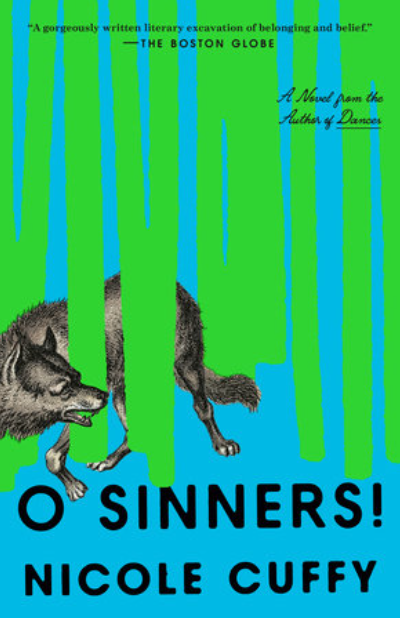
Given the endless musings on life and death that humanity has penned over the past eon, it can be difficult for a new title to contribute to the conversation in a way that feels fresh. But Nicole Cuffy’s O Sinners!, published by One World in March 2025, meets that challenge with teeth bared. It weaves mystery, philosophy, and a touch of magic into a multi-genre structure, all while stripping mortality from its usual dance partner, morality, and adding in new choreography: that of beauty.
Bouncing between timelines, the book spans decades. In the present it follows Faruq, a grieving journalist, as he lives with, interviews, and writes about a commune-bordering-on-cult called “the nameless.” In the past it follows Odo, the man who will become the leader of the nameless, as he serves in the Vietnam War.
Throughout the narrative, Cuffy confronts the reader with morally ambiguous scenarios. Take this exchange between two Black soldiers, after one, nicknamed Preach, tells off the other, nicknamed Bigger, for using a racial slur when referring to the Viet Cong soldiers who have been making their lives pure hell:
Bigger widens his eyes.
Aren’t they trying to kill us? [he asks.]
Aren’t we trying to kill them? [Preach asks.]
Bigger goes silent. They’re all silent now. Is the jungle silent too? When they tell their stories to those who weren’t there, sometimes it will be, and sometimes it won’t.
This misremembering—or this purposeful skewing, the reader is never really sure—is an element Cuffy plays with throughout the novel: With a story about elephants chasing down a tiger—or vice versa. With flip-flopping names of foals. With fairytales that dance between parable and history. Since the reader is never sure what’s strictly true, it’s nearly impossible for them to take a moral temperature reading of any character or situation, and this trips up their ability to do one crucial thing: criticize.
And that’s the point.
“You see,” Odo tells Faruq, “we suffer because we’re born with these two eyes that see ugly better than they see beauty. We get all bent out of shape—distorted.”
While serving in Vietnam, Odo had to face an unbearable truth: he was only a hero to his fellow Americans. He was a villain to both the Viet Cong and to the Vietnamese citizens he was supposedly protecting. This wasn’t really news—Odo had lived an entire life of people deciding who and how he was—but it was the straw that fundamentally broke his concept of morality. There was simply no way to make a universally right decision—not in war, not as a Black man in America, not as a law-abiding citizen set on challenging societal norms. Everything comes down to perspective, and perspective comes down to choice.
Bigger goes silent. They’re all silent now. Is the jungle silent too? When they tell their stories to those who weren’t there, sometimes it will be, and sometimes it won’t.
As the leader of the nameless, Odo wants his followers to recognize that they can choose to see the beauty around them. To see that life is beauty; that to exist is beautiful. And this includes everything about existence—even the moments when the candle wavers, when it bleeds wax, when it coughs sparks. When it dies.
Chaos. Distortion. Ugliness. It’s all the same: a mental pushback against the most natural thing in the world—death. We’re afraid that if we aren’t good enough in life, we aren’t going to be granted goodness after it, and this fear separates us from reality, makes us pull our existence apart into whatever narrative serves us best in the moment—whatever narrative makes us seem most good. And we become so focused on that self-fulfilling prophecy of moral superiority that we fail to gaze about for opportunities to actually do good. And so then we never feel good.
And we get all bent out of shape—distorted.
But what if we didn’t have to worry about our goodness at all? What if, instead of being judged on what we gave to the world, we were judged on the perspective we took away from it? What if, by seeing beauty first and foremost, no matter the situation, we in turn could be seen as beautiful first and foremost, no matter the situation? What if we could become a portal for that beauty, an embodiment of it, simply by allowing it to exist? And what if that, in turn, made us good?
Our modern gaze has been flattened in many ways. When a majority of communication happens via the internet, a medium void of nuance, we become very bad at taking moral temperature readings, but we also feel very pressured to do so. We’re constantly bombarded with messages that something is right or wrong and that we, therefore, are right or wrong. We become righteous about our rightness, defensive of our wrongness. We desperately try to stack ourselves into a social-moral hierarchy, even though some of us are using Jenga blocks, some LEGO blocks, some Tinkertoys, some raw materials.
Odo’s challenge to his followers is this: Take true pain and find true joy in it. Take true remorse and find true gratefulness in it. Take true injustice and find true stewardship in it. In short: take true ugliness and find true beauty in it. And then look over your shoulder and see, just see, if you don’t find waves of goodness lapping in your wake.
Faruq, who lost both parents too young, sees morality as a compass. He has to; if he recognizes its shortcomings, he would also have to recognize the shortcomings of his father, a stringently moral man. And, in turn, he would have to recognize how badly said moral stringency hurt his mother. But Odo, who watched bullets and shrapnel tear men apart regardless of principle or belief or creed, who watched men tear each other apart based on principle or belief or creed, sees morality as a false god. And ultimately, that’s what makes him dangerous.
But does it make him wrong?
“The truth about a black panther, scholar,” Odo tells Faruq, “is that, really, he’s either a leopard or a jaguar. So he’s either a shape-shifter, or he doesn’t exist at all.”
Savannah Brooks earned her MFA in creative writing from Hamline University and spent the first decade of her career working in publishing, first as an editor and then as a literary agent. Her writing has been featured in the Guardian, Hobart, and Prime Number Magazines, among other publications. You can find more at savannahbrooks.com.