
STRANGE GIFT, Veronica Kornberg, Wandering Aengus Press, PO Box 334, Eastsound, WA 98245, 2026, 75 pages, $20.00 paper, www.wanderingaenguspress.com.
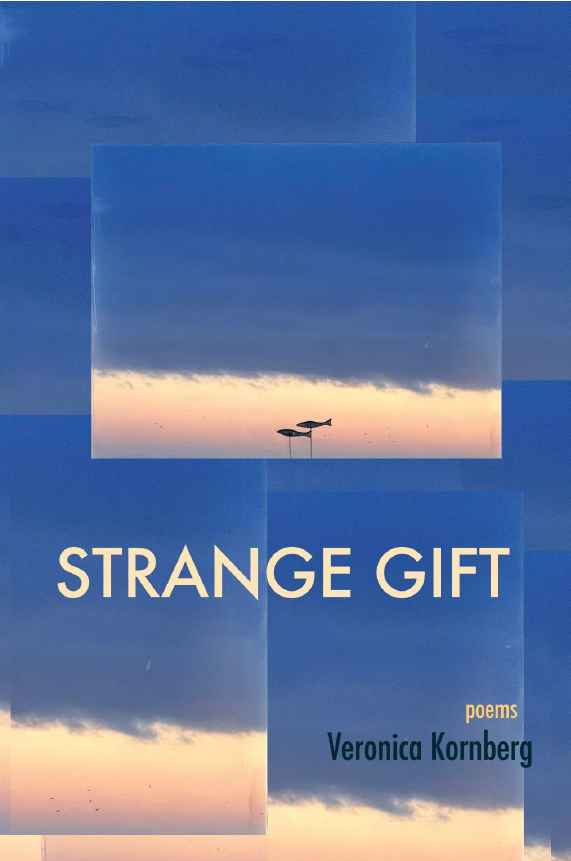
Every living thing is just a bit odd. Strange, in fact. Which is why the cover of Veronica Kornberg’s masterful debut, Strange Gift, strikes a chord of resonance: two fish traverse a cobalt sky, a cloud-encrusted horizon, grit of salt on a window pane. These elemental images carry the liminal and layered reality of this collection, while the author’s obsession with language grounds us within a teeming dialogue of love and loss.
Right from the onset, we are plunged into the dirt of Kornberg’s cliffside garden on California’s Central Coast, but more exquisitely, into the burgeoning soil of her sharp intellect as in the poem “Improvident”:
…we chimed the names
of everything around us—
wrack line, blackberry, wentletrap
wooly sea daisy and gumboot chiton.
We took it all on faith, as is.
But within these pages, Kornberg is not content to simply introduce us to the volume of plant species, sea urchins, and birds that occupy her environment; she invites us into the watery abyss of adolescent memory, as in the title poem “Strange Gift,” where the speaker is crouched in her mother’s closet observing a conversation between the ghosts of Joyce Carol Oates and Emily Dickinson.
…and I thought maybe there was a place for me in this world,
a little side street off the parade route. It was the quiet I craved,
and this conversation between the living and the long dead
The long dead feature in Kornberg’s poems, and she is aptly tender with the ripples of loss that permeate an expansive life. For example, in “Brogues,” we learn that the speaker’s memento after her father’s death are his pair of brogues—for treading the boggy places, / punched full of weepholes to let the water drain. This delicate imagery exerts itself powerfully, giving permission to the metaphor of grief that must leach from the body.
Additionally, “Fragment” is a poem in which Kornberg tunnels into the brutality of incremental loss—her mother, afflicted by dementia. It was lovely to see you, as though we’re old friends, met for lunch. Later, a daughter leaving home evokes a private interiority: I do not say it—world, world, please / do not hurt her. These are moments we register with alacrity because Kornberg shows us that grief is as unstoppable and inevitable as love, the two symbiotic. To this end, there are lyric sequences throughout the collection that may appear simplistic but are actually an astute aligning of what is vast, glorious, and infinitely unsalvageable: …No matter you’re called / bog, mosquito trap, quagmire […] I know you are meant / to disappear (“To an Oxbow Lake”).
It was the quiet I craved, and this conversation between the living and the long dead.
Consistent with this undercurrent of grief, Kornberg implicates patriarchal rules of control as a source of trauma for women. In “Gift Set,” the speaker examines a Catholic Pocket Manual found in her mother’s lingerie drawer after her death, which she proceeds to name mostly hokum to me […]power moves over the lives of women. The speaker likens the book to a blocky yellow tooth or lady’s pearl-handled gun […] dangerous beneath her fingertips, a depiction that is startling and intentional, pointing to the historically violent nature of dogma inflicted on the feminine.
Likewise, in the poem “My Sister,” we encounter the speaker, her mother and sisters, visiting her sister Annie in a coma hospital. When Annie, in a brief burst of verbal ability, looks at her mother and says, “She is scary,” the mother makes light of the situation. The adolescent speaker responds:
It was the most
adult thing I’ve ever seen,
the way she swallowed that pain
and turned it into a sweet
lick of icing, a joke, a little nothing.
God it was awful.
Here, Kornberg points to the societal expectation that women suppress emotion. Further on in this same poem, the speaker shares a hotel room with her mother and sisters and she begins jumping on a mattress, until we were all laughing— / we laughed and laughed until / we cried we were laughing so hard. One can’t help but feel the tragedy laced within these lines. We are a generation of women born of women, and many of us must consciously choose to allow ourselves the dignity of the felt emotion. Kornberg does not argue, nor does she righteously deliver her commentary about oppression. She observes and allows the reader a moment of self-inquiry, and ultimately, a choice to be free.
Throughout this collection, Kornberg’s balm for suffering is her connection with the natural world. In “Soft Ground,” she credits nature’s transformative capacity: “Astonishing, how a person can be // changed entirely by the scent of sage and coyote mint, / by the quick tongues of painted ladies that swarm the sea daisies […].
Yet inherent in change is loss. From tides that nightly sweep the speaker’s footprints away to the moment when each bloom detaches […]—goodbye and sweet goodbye, (“Farewell-to-Spring”), Kornberg embraces impermanence. In “Winter Wallop” a storm erodes the terrain:
The mountain fell into the road,
the road fell into the sea,
cypress fell along the fence line
From germination to bloom to dormancy or death, from cliffs that deteriorate to drought that renders landscapes uninhabitable, the galaxy in these poems evolves as intended. There is no animosity in this collection, but a heroic striving toward acceptance and an acute pursuit of the present. We willingly dig alongside Kornberg, allow our hands and thoughts to be yoked to the earth. Much like a mycorrhizal network, these poems murmur to each other of sublime strangeness, of the vulnerable soul alive as irrepressible / growth waiting in the deep (“The Work”). These poems seep and sway and guide us into consciousness lit with possibility.
Paola Bruni’s work has been published in The Southern Review, Ploughshares, Rattle, and elsewhere. She has received numerous Pushcart Nominations and prizes. Her debut poetry collection is titled how do you spell the sound of crickets (Paper Angel Press, 2022). She lives in Aptos, CA, by the sea.