
WATCHING FROM THE BLEACHERS, Eileen Ivey Sirota. Finishing Line Press, PO Box 1626 Georgetown, KY 40324, 2024, 39 pages, $19.99 paper, www.finishinglinepress.com.
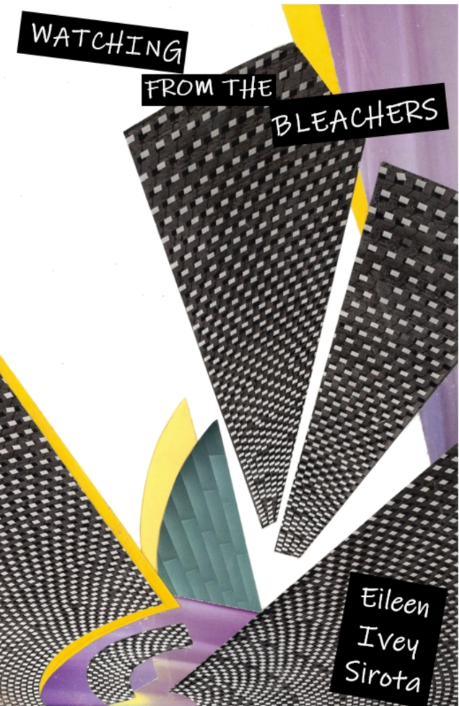
In Watching from the Bleachers, poet Eileen Ivey Sirota deconstructs the act of seeing—calling out our subjective vision: who frames what we see, what we miss, and what’s maybe moving just outside the frame. The pandemic setting amplifies everything. For poets like Sirota, when the world fell apart, new worlds split open, and unexpected movement stirs in the margins.
The book begins with dropped earrings—lost under the bleachers at a public event. The image is original and telling: the speaker is abruptly stranded, her access cut off to her old possessions, but also suddenly seeing what was beneath her all along. The bleachers are a metaphor for youthful diversions, for passive spectatorship in America, and for how easily one becomes stuck when something important is lost from view. From this opening moment, the speaker steps into the new frame. She begins to look—really look—at herself (as an educated, older, white cis woman), her country, her privilege, and the lives all around her that have long gone unseen.
So many ways of killing—the bullet, the blanket, the exile, the pretending, the silence. The silence.
Positionality, Isolation, and Urgency
This collection is part of pandemic literature, yes—but it’s also a great departure from it. While others pondered home, Sirota moves beyond domestic walls to evoke a larger, more political landscape. Early on, she draws contrasts between the personal and political lenses we’re handed. She realizes, in short, that we too often turn out the lights on what we don’t want to see in our comfortable shared house of privilege. The speaker questions the very act of sight, its implications, and its blind spots.
A standout line in “Turning Over the Keys” (a strong poem on the Presidential Inauguration) is this: One more time / we put the key in the ignition and listen— / straining to hear a faint, hopeful hum. She juxtaposes a broken-down American car with the battered ideal of democracy during Trump’s ascension. Ordinary symbols become haunting, especially as the poem reveals how unsuspecting Americans are gaslit and made to doubt their own vision.
In “Whitewash,” she excavates history and its erasures: So many ways of killing—the bullet, the blanket, / the exile, the pretending, the silence. / The silence. The silence itself is a weapon—and Sirota uses repetition and rhythm to name it in full. Seeing points to and interrupts silence.
Political Seeing/Emotional Cost
The book asks whether seeing is enough—or whether action must follow. In “Our House,” a poem both personal and societal, Sirota describes the cost of silence within the walls we build: We live in the most flawless house… / We never go down to the basement. And when she does go there, she finds: The names are stuffed in the basement / Rayshard, George, Breonna, Ahmaud, Philando… / There are no lights in the basement— / that way we can’t see. This stanza stops the breath. It says everything about how systems operate and how Americans hide truths beneath polished surfaces. This is one of the strongest poems in the collection, bringing recent Black murders to date into the kind of compressed field of vision the pandemic engendered.
And as a cis white woman, the speaker implicates herself. The poems are direct—there is no coy language when she addresses anti-Black violence and national silence. Speaking of performative grief, she writes: Useless as nipples on a tomcat: / white woman tears. It’s one of the boldest lines in the collection. Sirota acknowledges the inadequacy of remorse and insists instead on accountability. She doesn’t easily blink.
The Everyday and the Image-Making Eye
The brilliance of this collection lies in its pairing of sharp critique with tender observation: both must happen together, again highlighted in the forced closeness of pandemic viewing. In “Rinsed Spaghetti,” the speaker recalls her honeymoon: a moment when her husband feeds her pasta becomes a portal to time travel, memory, stillness. The pandemic telescopes the moment backward, playing with distance and angle. She writes her way into the window frame—and then opens it wide.
She also invokes art—taking on Earle Richardson’s painting, Employment of Negroes in Agriculture (1934), in the poem “Rise Up.” The depicted workers spring into life. A man falls from a window, and the line goes: The cement rises up to meet him. Even gravity becomes suspect, made political. The image vibrates with shared witnessing as it rests, looking back at us where words failed the subjects.
Sirota moves between stories, modes, and time periods, always with one eye locked on the reader. At times we watch a football field. At other times we see a calendar full of empty, waiting boxes. Either way, she reminds us: we just can’t see it—until we learn how.
Sight as Resistance
Ultimately, Sirota leaves us with a gentle but potent dare: once we learn to see, we can’t unsee. Her poems are stitched with political reflection and personal truth, reminding us that revelation doesn’t come with comfort. It comes with clarity.
Watching from the Bleachers ultimately shows us that spectatorship itself is a privilege. The pandemic, political unrest, and personal reckonings are intertwined—and Sirota walks that line with humility and edge. This is poetry that understands what’s at stake when we drop what was once ornamental—and reach beneath the bleachers to retrieve it.
Once the light flips on, we don’t get to look away.
Gale E. Hemmann is a writer and poet living in the Olympia, WA, area. She has Master’s in writing from Pacific and a BA from Smith College. She just completed her first manuscript, The Mannequins, a novel in sonnets. A bibliophile, she is a frequent contributor to Rain Taxi and ForeWord Books, teaches nonprofit grant writing, and works with Annie Finch in meter circles as sacred (metrical) time, where the waves meet the shore by music.