
WHAT A FISH LOOKS LIKE, Syr Hayati Beker. Stelliform Press, Canada, 2025, 222 pages, $15.99 US, paper, www.stelliform.press.
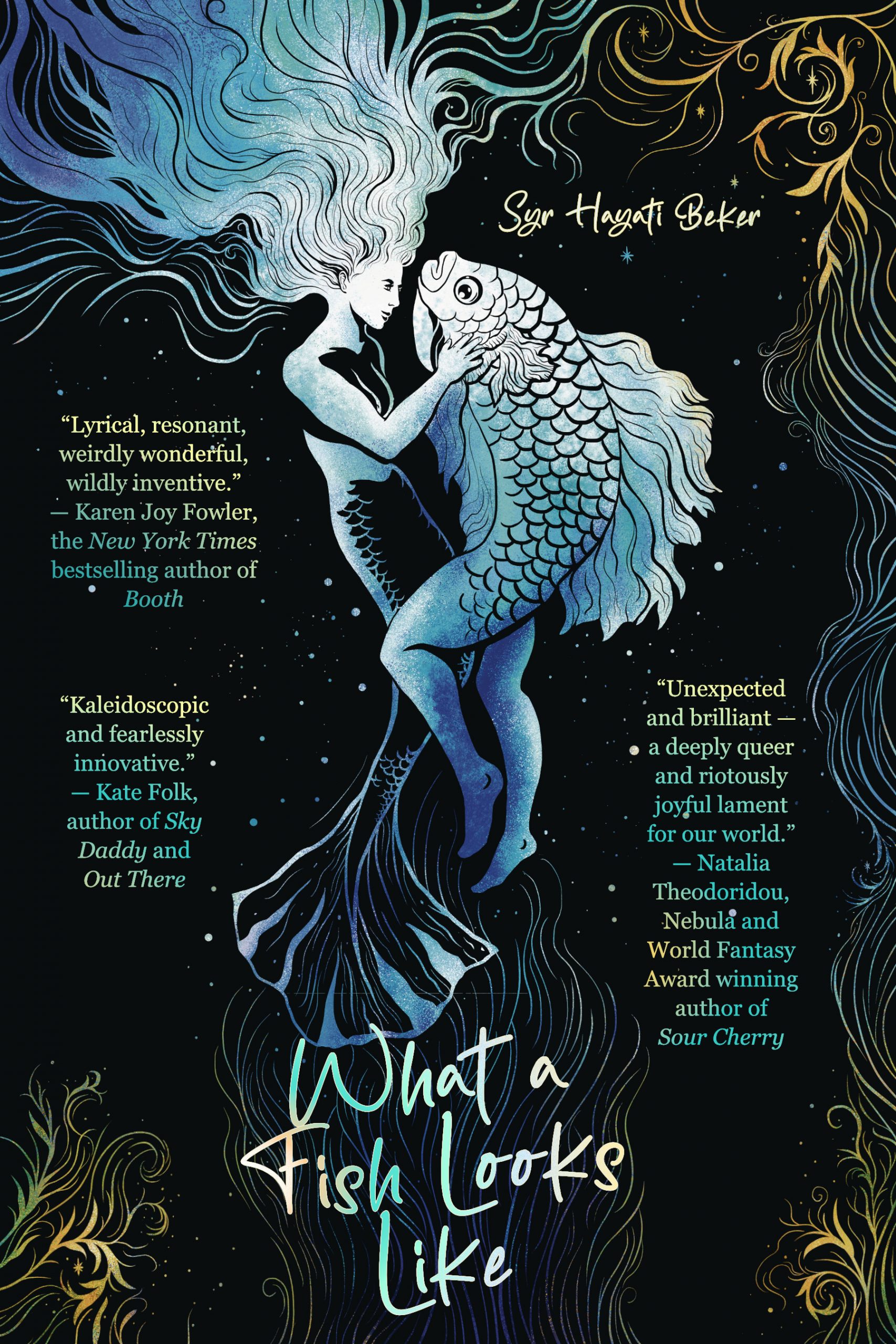
Queer, surreal, and dystopic, What a Fish Looks Like traces the end of the world as we know it through a small group of people trying hard to survive the death of forests and oceans, of everything they thought mattered. The world is burning, vine growing before their eyes, and no going back.
Seb might be metaphorically drowning, or reaching for love, or barely surviving but not leaving the planet for a better world on the transport, Exodus 3. Exodus 1 crashed and burned. Exodus 2 might have arrived somewhere safely, but no one has heard. No one knows where the 100 tickets for Exodus 3 came from. There are rumors.
These stories rattle right along, sometimes claiming to be fairytales, sometimes claiming to be letters from Seb to Jay and to Seb from Jay, actual conversations, flyers posted on lamp posts on Heare Street, or a record of recent history as random notes scrawled on a bathroom wall.
I find myself filled with the kind of rage that makes me a terrible choice for a polar bear.
In the not-too-distant future, ecosystems folded like cardboard animals in a pop-up book, goodnight. Science, Government, and Tech withdrew their promises, one by one … Why did we believe them all along?
Extinct species such as arctic foxes and porpoises have been preserved genetically. An oceanographer, is caught between those running away from a dying world and “ghosting” DNA to transition to an extinct lifeform in order to preserve it.
In those early days, we laughed at headlines like “Hope for the Dodo: Could Humans Adopt Animal DNA?” Ghosting offices appeared, open for volunteers. It was a pharmaceutical solution, a practical solution. What do you do with extincting species? Inject them directly into your veins.
After they do, they’re thinking ice and snow and fur between legs and how their friend who carries seal DNA looks tempting. I find myself filled with the kind of rage that makes me a terrible choice for a polar bear. Making this choice to ghost is addressed to a former lover who will never return. They lay that earlier experience against this becoming something else.
It’s not like sharing a bed, struggling at first and then finding a rhythm. It’s not like grafting an apricot branch to a plum tree. It is: your DNA turned into a factory for the DNA of extinct species until the day the world is safe enough that we can let the ghosts out, resurrected. Until then, it’s a shorter life, but maybe less lonely. Maybe that’s all there ever was.
A teacher, “Mr. D,” struggles with the tragic death of a student and prepares to come out as trans: The circumstances being that she needed to get out of here before someone decided the wave was her fault. This while oceans are drowning.
The B. Collective, the B. Gay Do Crime Collective, the No Exit Theater, Saint Sebastian the Persecuted, The Paradise. Team Ship. Team Earth. A dangerous vine wraps around the wheels of an overturned self-driving ice cream truck, and Seb is allergic. A production of Antigone, checkpoints all over the cities, masks because the air can kill, fires and ash choke the air, and guards on the bridges. This is surreal future destruction enlivened by people with humor and style. Listen, we’ll say, you can always become anything you want, all you ever needed was people to see you. The rest is adaptation.
What does a fish look like? Will anyone remember in the future? Will anyone still be here to remember? Does humanity stay put, stick it out, and find a way to survive on Earth? Or does humanity take a chance on escaping to another planet far, far away?
Know that we can’t save anyone from themselves and despite the sweet cover of this novel, this is not how we tell a story. See you in the after, and don’t expect a happy ending.
Jan Priddy’s writing has earned an Oregon Literary Arts Fellowship, Arts & Letters fellowship, Pushcart nomination, and numerous publications. An MFA graduate from Pacific University, her novel, All the Daughters Sing, finds hope in the world after [most] everyone dies and seeks publication. She blogs at IMPERFECT PATIENCE: https://janpriddyoregon.wordpress.com.