
Wonderwork, Sandra Fees. BlazeVOX [books], 131 Euclid Ave, Kenmore, KY 14217, 2024, 74 pages, $18.00 paper, www.blazevox.org.
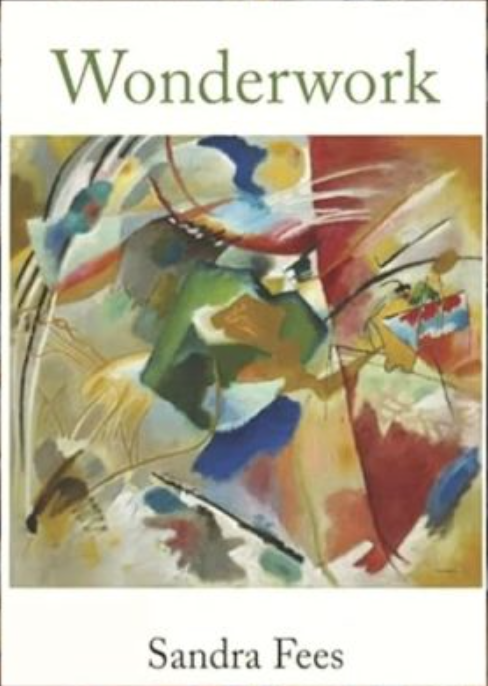
If tone can be captured, Sandra Fees has gently pinned it down the way one would an insect. There is an exactitude. In her first full-length collection Wonderwork, published by BlazeVOX Books, the author opens up a mystery with lyric vocabulary, choice of words, and pairings of words and phrases, part and parcel with her ear.
An initial reading of a book focused on a minster leaving a career in ministry finds agreeable sisters in theology and philosophy. Yet a deeper reading belies tension. How can she leave? It is an impossibility. Through the process we witness the deeper churnings of a woman who serves others, and with each poem we find wisdom and an openness to seek choices.
There is the practical “When I Quit My Job My Yoga Instructor Teaches Me Rubbing Hands,” with eastern philosophy and the image of crickets, one wing against another. These are the wings of insects or us, or something of breath in the air. The delicate details in this instructive poem are not just gorgeous functionaries but also a map to read Fees’ work as a whole. The cupped hands, the eyelids, the coffee grinds—all open up to the larger whole where we find the wisdom in the piece, as is the case for each poem in the manuscript.
Yet the gift in this piece is where we learn there’s not enough of anything to set my hands on fire, where the speaker desires something more than a quiet presence. She makes a fire, adding oxygen into her naked hands. I blow / a mantra into my curved hands…. This woman is capable of creation, possibly a deity, or a version of the creation myth where the daughter of God has power. She says, I could go on, name every scrap, / the clipped comments, the unwashed cups. The household is represented in the cups, a tiny detail that needs tending to. This woman has the power to name things, like a god, where the codifying of objects suggests the naming of living creatures, where a whole world is created. Through this process, Fees empowers us too. Or is the speaker saying to us, Don’t you too hunger to become empowered, and within that feeling, become a fire? Perhaps through the calm language here, there is a deeper feeling of rage.
There’s not enough of anything to set my hands on fire
With “Inner Cosmology,” we encounter outer space—in the sky, in branches, in existence, which bridges the intimacy of the speaker’s mother and father with a casual term, binge-watch, and the everyday lining of kitchen shelves. But don’t be fooled. Even straightforward phrases are laden with connections that form a constellation. Inner becomes outer and vice versa. Indeed, it’s hard to speak about this collection without sounding conceptual.
How does Fees lead us through these conceptual spaces? What attracted me to her writing is the lyric voice, the instrument of a true artist where music and word choice are optimized. Take, for example, “And the Stars in Their Mouths,” where we are led to a lofty place we’d rather not leave. Fees writes, And above us, / another field of wilder / horses that plume / into constellations that know / how to wait, that know / to love this broken night. She takes us on a smooth ride from wilder, which perches over plume, over constellations, terms that are open and far roaming, not harsh. Not until we read down to the abrupt broken night do we bite off something sharp. The night sticks in our throats, ragged and final.
We need to examine, however, the stanza prior, to see how she makes full use of another way of being, and how the two sections contrast with each other. Fees writes, But for now, the sinewy / smell of thunder, the cadence / of downpour. This is what we’ve waited for, she is saying, where rain has a beat and thunder is imbued with a natural fibrous tissue, a texture. Yet the for now alerts us that this is one pause of many that will pleasure our senses, eradicating thoughts. This is meditation. This is a Buddhist connection with all things, a sensory overload if you will. Further, sinewy can refer to plant matter or an animal, or, being a descriptive word, it can enhance whatever it attaches itself to, both in the poem and for ourselves, in our own moments.
The bridge of theology and philosophy might feel like an argument or rough terrain in someone else’s hands. Here we have tension with a fine-tuned instrument. Here, with Fees’ guidance, we are the ones wondering at the constellations of her writing, at her wonderwork.
Laurel Benjamin’s book, Flowers on a Train (Sheila-Na-Gig Editions, 2025), is a finalist for the Cider Press Book Award and received an Honorable Mention for the Small Harbor Publishing Laureate Prize. Forthcoming is Written into the Curve of the Sea’s Open Throat (Shanti Arts, 2026). A San Francisco Bay Area poet, she is active with the Women’s Poetry Salon and is a reader for Common Ground Review. She founded and leads Ekphrastic Writers, a group dedicated to writing and community. Publications: Pirene’s Fountain, Lily Poetry Review, Cider Press Review, Taos Journal of Poetry, Mom Egg Review, Gone Lawn, Nixes Mate. Her work has also been anthologized in Women in a Golden State (Gunpowder Press, 2025), The Nature of Our Times: Poems on America’s Land, Waters, Wildlife, and Other Natural Wonders (2025), among others. Laurel holds an MFA from Mills College. She invented a secret language with her brother. Read her work at laurelbenjamin.com.