
FIRE AT THE BIG TOP, Sandra Yannone. Moonpath Press, PO Box 2220
Newport, OR 97365, 60 pages, $16.99 cloth, 2026. https://moonpathpress.com.
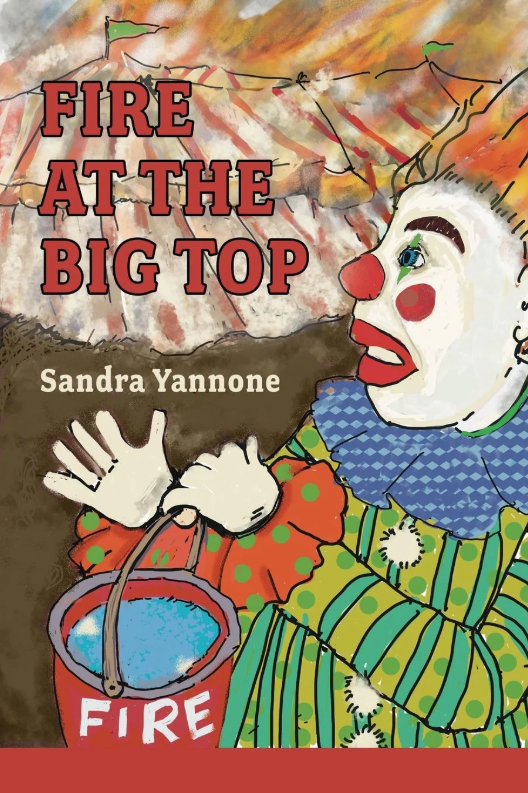
We often see things clearly in the shocking light of flame. When something burns, it creates smoke, but it also illuminates. Sandra “Sly” Yannone’s Fire at the Big Top arrives eighty years after the Hartford circus fire of 1944—a disaster that claimed 167 lives beneath a canvas tent soaked in paraffin and gasoline. Yannone’s own father was in attendance that day and survived. The book is a eulogy to his childhood innocence and the smoke-filled trauma that never quite left him. His story weaves through that of his poet daughter. The flames of his fire meld into hers. The heat of human passion ignites her own tangled relationship of combustible desire.
The circus becomes a brightly lit tent where human story plays out—love, danger, spectacle, death. It is handled brilliantly in Yannone’s experienced formalist verse. The light between her late father’s life and hers illuminates every scene.
Voice and Witness
The touchstone of the book is the poet’s witnessing of her father’s survival story. After escaping the fire, he was never the same. As an adult, he constantly thought he smelled smoke—a condition called phantosmia, the phantom perception of burning. In the memorable poem “Phantosmia,” Yannone writes:
my father swore up and down
For months on end
He smelled something burning…
Go down and check the furnace
Can’t you smell it?
Are you sure?
Are you sure?
The repetition captures both his insistence and her doubt. Later in the poem, she adds: And I started not to believe him, the doctor I mean, / The more my father spun his fiery tale.
The end line is powerful and transitions us fully into the “circus world” of the book, where the literal and fantastical co-exist as people grapple with complex realities across decades. Yannone is both story-bearer and loyal witness at all times.
History as Lyric
One of the most powerful poems in the collection is “The Morgue.” After the fire, Yannone’s father was taken to a morgue by his own father—perhaps a misguided attempt to cultivate the child’s gratitude for having survived. He is forced to see the bodies of people who weren’t so lucky. He was, she writes, never lonely again.
This is one of the most haunting lines of the book. Survival marked him. He carried the dead with him. No wonder he never spoke of it until his later years.
There is a beautiful and curious sense of distancing as Yannone grapples with the impact the fire had on her father and her own sense of dissociation from traumatic experiences. For example, in a love poem, Yannone writes, my hands outcast themselves / they roll up my sleeves. There is always a feeling of love and also heat nearby, of dancing among hot coals.
And then we chose to dare. We chose to lose each other in the air.
Fire and Desire: The Circus Corona Sequence
The second half of the book turns from elegy to romantic fire. Yannone’s circus becomes a stage for love, precarious and dazzling. A sequence of persona poems, in the form of a sonnet corona, takes on the voices of circus performers: named Lion Tamer, Sword Swallower, Trapeze Artist, Fat Lady. Each figure embodies a different imagining of two lovers. The circus is reclaimed as free and magical.
The physicality of the poem “Trapeze” is especially strong. Yannone writes: And then we chose to dare. We chose to lose / Each other in the air.
In the next stanza, the lover is literally catching her— a beautiful physical embodiment of stanza breaks, showing how vulnerable the lovers are as they leap and (almost) know the other one is there to catch them. The physicality and tight rhyme of the love poems are some of the most poetically striking moments in the book. Rhymes can show congruence or difference among two things, and Yannone uses rhyme powerfully to stage the lovers’ dynamics. In the “Wire Walkers,” she notes: …See how gleefully / Each perilous step toward the other breaks free?
In another marvelous rhyme, she chronicles falling out of love: I become the flying trick card. / And for the air I whip of air I create? / I crack it hard.
Rhyme underscores passion. In this sequence, we see the circus’s extravagance, danger, and surrealism all in the lovers’ circus tent.
Craft and Structure: Holding the Tent Up
Yannone is a masterful storyteller and an organic, accomplished formalist. Somewhat like a circus ringleader, she uses rhyme and line breaks for powerful effect—childhood-like rhymes about parents, lovers quarreling in off-rhymes, and perfect rhyme where lovers come together. The sonnets and rhyming poems work as a container for a serious historical subject matter and the intensity of feeling played across generations and time.
Ending: Embers on the Road
After traversing flame, the book ends with smoldering hope. The final poem, “I Attend a Sin—An Erasure,” uses a scattered, fragmented format on the page. Words float like embers as she contemplates the fire, still. It traces the fire from a physical point of view: the speaker steps into the burning tent, where burning yellow turned itself into a circus … a sandy floor caught dark red. There are scattered bits of word-debris on the page. Yannone recalls, bodies, yawning with black. The words are spread out, broken mid-line, almost as if the viewer is walking in or around the physical wreckage of the circus. These images are familiar, but the “broken” erasure form is particularly haunting. The final poem’s sequence surprises when it ends with hope: light emerging… beside a road. It seems after all the flame and smoke, this shape poem is Yannone finally looking back at the scattered embers. With us in their glow.
Fire at the Big Top is Yannone’s third full-length work. She carefully inscribes her story of queer, feminist womanhood into some of the nation’s most notable historic incidents as a poet of passionate witness. A poetic magician and lantern-holder, she leads us boldly down a bright and wild trail.
Gale E. Hemmann is a writer and poet living in the Olympia, WA, area. She has Master’s in writing from Pacific and a BA from Smith College. She just completed her first manuscript, The Mannequins, a novel in sonnets. A bibliophile, she is a frequent contributor to Rain Taxi and ForeWord Books, teaches nonprofit grant writing, and works with Annie Finch in meter circles as sacred (metrical) time, where the waves meet the shore by music.