
THE NEW LIFE, Wendy Wisner. Cornerstone Press, University of Wisconsin-Stevens Point, 2100 Main Street, Stevens Point, WI 54481, 2024, 82 pages, $19.95 paper. www.uwsp.edu/english/cornerstone.
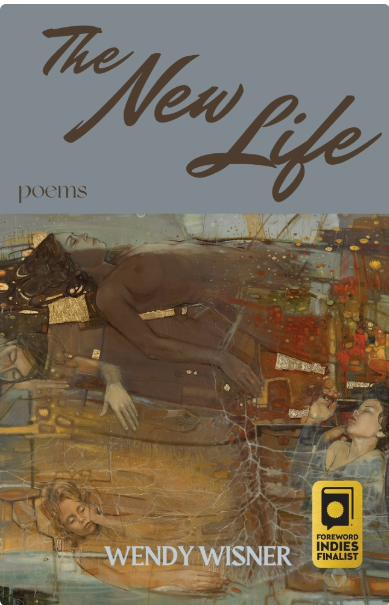
If you want a reader to appreciate the difficulty of starting over—of painfully building trust, allowing in love, letting go of grief—you have to start where it hurts. Wendy Wisner’s The New Life begins with her own mother’s birth, so you get the sense early that grief and trauma are inherited things, given to the author early and processed only with great effort. That process envelops this collection, where each poem teases, insinuates, conceals, and then drags its heavy meaning into the next. You have to collect all the weight of the old life first before you get the new.
In the very first poem, “Solstice,” the poet is already seeking meaning in examining the past: I want / only this: to see my mother born. The imagery is stark, unsettling: in the waiting room, her mother’s father sat in his gray clothes / holding his son, Raphael, / the angel…. / My mother’s eyes were root black, / still adjusting to the light. The father is gray, mundane, nearly lifeless; the son is celestial; the mother is described in a way that is nearly demonic. Nothing about the picture indicates joy or celebration but rather people who are sharing a space but not connecting with each other.
As I read, I found myself dreading what would happen to this family, and Wisner provided just enough to validate the feeling: Later, the steady unraveling of a family—. The em dash cuts it off, a theme throughout this collection. The feelings that are too strong and too painful are left as subtext so that you’re tempted to follow them through each poem, infer the worst, as in “The Garden” (We watch our father finger the edges / of his blood-red poppies. // Bruised plums hit dry ground) or in “I died, and lost flight” (I was a child. / Did you believe me? / I learned / to hold the letters / in the roof of my mouth). But you’re rarely given more than that, the horrifying implication that things happened that are too painful to look at directly or put into words.
I was a child. Did you believe me? I learned to hold the letters in the roof of my mouth.
As the collection goes on and Wisner marries and raises a family, she begins highlighting the juxtaposition of her new life with her old, the unpleasant mixture of a loving marriage with the belief that it isn’t real or won’t last: I have a husband. There is nothing wrong with him. / He loves me. He loves our children. / But I don’t trust it. Not him. It (“Marriage”). Then bigger concepts get stuffed in a blender together, as in “December Wind,” where the poet dreams she’s about to give birth to her son, though it’s written nearly like a miscarriage: Last night I dreamt I was bleeding, two cold gushes down my thigh. Upon waking, she remembers her grandmother dying, gray lips open, / the softest moan filling the room / then ending. Though there might be something like despair in connecting her son’s impending birth with the loss of her grandmother, the poem ends on renewal (that new life again):
I have taught you to love,
night after night gliding my hands
down your rocky body
the way Demeter would collapse
suddenly to her knees
and begin to feel
her daughter’s dark descent.
The descent, traditionally associated with Persephone returning to Hades and triggering the onset of winter, is now linked to the dropping of the baby into the birth canal, the herald of life rather than death.
My absolute favorite poem that manages this magic trick of juxtaposition is “Milk,” wherein the poet sits with a woman deep in grief:
She hasn’t eaten in days.
But there’s milk.
She squeezes it out
like I showed her
when her daughter was alive.
A mother starving while she produces literal food is heartbreaking enough, but it’s made all the worse from the knowledge that the food is going to waste—the baby has died, and the milk has to be expressed so it doesn’t cause mastitis, infection, more death. It’s the ending that gutted me, though, as Wisner has one more twist of the knife:
I tell her I remember
that her daughter loved Elmo.
She asks if I would like a sandwich.
She says, We have so much food.
This is where Wisner shines, showing the love and support (in her speaker’s own position, in the support and care of family and community) while never flinching from that pain that can overshadow everything, blot it all out.
Sometimes the poet is sideswiped by happiness, although it is always tempered with a certain guarded pessimism, a refusal to look away from the darkest possibilities. The new life she is building is clearly hard earned and at the same time subject to a certain capriciousness of the universe. Near the end of the collection, “Shedding” gave me that glimpse of growth, surprising and inconsistent and effervescent:
What I’m trying to say is
sometimes your old skin
falls breathlessly off your body
in late April, as you slice
a cucumber into half moons
for your child,
and you just stand there
and let it.
For Wisner, there may be no clear transition from old to new—you may retain your previous scars in a messy, painful jumble—but sometimes, without having realized it, without having to let go of the old hurts, you can suddenly, joyfully, be different.
Brenna Crotty is the Senior Editor at CALYX Press, a technical editor, and the author of humor articles for Cracked and College Humor. She lives in Portland, OR, with her husband, son, and cat.