
HOME BEFORE DARK, Eva Björg Ægisdóttir. English eBook Edition. Orenda Books 16 Carson Road London SE21 8HU, 2025, 300, $15.99 paper, https://orendabooks.co.uk/product/home-before-dark
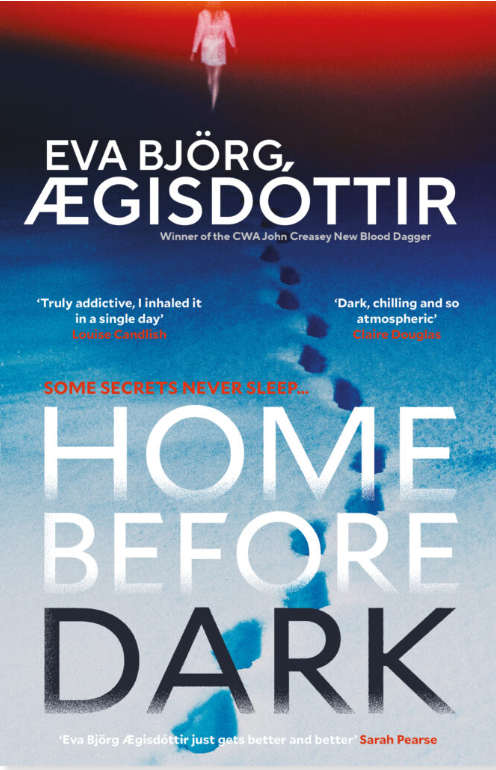
This is a book meant to be read more than once, the first time for the sheer thrill of the mystery and the second to see how it was possible to miss the obvious clues. Eva Björg Ægisdóttir brings to life the eerie and darker parts of the Icelandic countryside in Home Before Dark. If there is an underlying theme for this story, it would be guilt, what it can do to the mind, and how it can shape an unreliable narrator who doesn’t realize how broken her reality is as she works at solving the mystery of her sister Stína’s disappearance.
Ægisdóttir immerses the reader in the small fictional Icelandic town of Hvítársíða where the main character, Marsí, has returned to her childhood home for the tenth anniversary of when her older sister went missing, leaving behind no clues but a bloodstained anorak. Readers get a glimpse into the variety of ways a family can grieve. Marsí must come to terms with the fact that she might never find out the truth and deal with her overwhelming guilt. This is all accompanied by the backdrop of freezing terrain and a place where everyone knows each other. Just because the town is small doesn’t mean the secrets are.
The novel’s plot reveals overlapping mysteries, such as the reappearance of Marsí’s pen pal, what made Stína walk home that night, and the unexplained death of a girl on the same stretch of road on the same night of Marsí’s return. These things weigh heavily on the main character because she believes that everything that has happened is her fault. Her guilt overwhelms her, causes her to be restless, to drink and pull her own hair out: I should have come clean ten years ago. If only I had come forwards then, Stína might have been found and I wouldn’t be receiving letters like this all these years later.
Constant thoughts of regret and what she should have done give readers an insight into why Marsí is so driven to make things right, to find out the truth no matter the consequences. There is a rhythm of Marsí replaying events from her childhood and realizing she was being consumed by her own self-interest at the time, then switching to Stína’s perspective and how aware of the world she was, which creates a balance that draws the story seamlessly together.
I should have come clean ten years ago. If only I had come forwards then, Stína might have been found and I wouldn’t be receiving letters like this all these years later.
Ægisdóttir hints at Marsí being an unreliable narrator from very early on. However, it’s easy to want to forget and put full faith in her commitment to finding out what happened to her sister. I’d always had trouble distinguishing dreams from reality; they had a tendency to blur into one another and become confused. Often, I had the feeling neither could be trusted. Marsí realizes that she often can’t tell dream from reality or becomes so convinced of an idea that she misremembers it and believes it to be true, such as a time in childhood she could have sworn she went on a ride but hadn’t.
The back and forth between sisters gives the reader two sides to one situation. Ægisdóttir masterfully executes each swap at the most opportune moment, helping to build suspense while not interrupting the overall flow of the story. Including Stína’s perspective brings trust back to the main character and adds a new layer of mystery to the story. Through her interactions with members of the town, readers can’t help to be suspicious of everyone. Ægisdóttir keeps everyone interesting enough that it isn’t easy to focus on just one character even in a small town with a population no bigger than a thousand.
Part of Marsí’s guilt and delusions appear in the form of dreams. Dreams serve as signs, little hints, at the truths swirling around in Marsi’s mind.
Ægisdóttir uses dreams as a way to further confuse and disorientate Marsí. She struggles to distinguish real and not real. What was dream and what was reality. Whether her dreams mean danger or if they’re a sign to trust someone or not. At some point I dreamt about Mum. She was standing over me in a white nightie; then, reaching out a hand, she cut a hole in my stomach with a sharp fingernail. ‘Lie still, Marsí,’ she said. ‘Mum will fix you.’ Somewhere a bell was ringing. The use of dreams creates more doubt and a strangeness to the story. It helps throw the reader off while further absorbing them in the desire to continue reading.
Ægisdóttir writes for the mystery addict. She gives readers all of the information and also none at all. The way she weaves through the story creates tension on every page. Ægisdóttir has a strong grasp on how to slowly build suspense and pull the reader in many directions without leaving them lost or overwhelmed. She achieves her goal of portraying guilt as not a straight line, how too much of it can leave a person so broken they don’t have the ability to realize how bad it is.
Samantha Smith lives in Greenville, North Carolina, where she is an upcoming graduate student at East Carolina University, majoring in creative writing. She has worked as an editorial manager on the Fall 2024 volume of The Lookout and is currently an intern editor on the North Carolina Literary Review while writing her debut novel.