
An Interview with Julia Alvarez by Anaïs Godard
I keep returning to poetry because, of all the literary arts, it’s the one closest to silence.
Anaïs Godard: Hello everyone, and welcome.
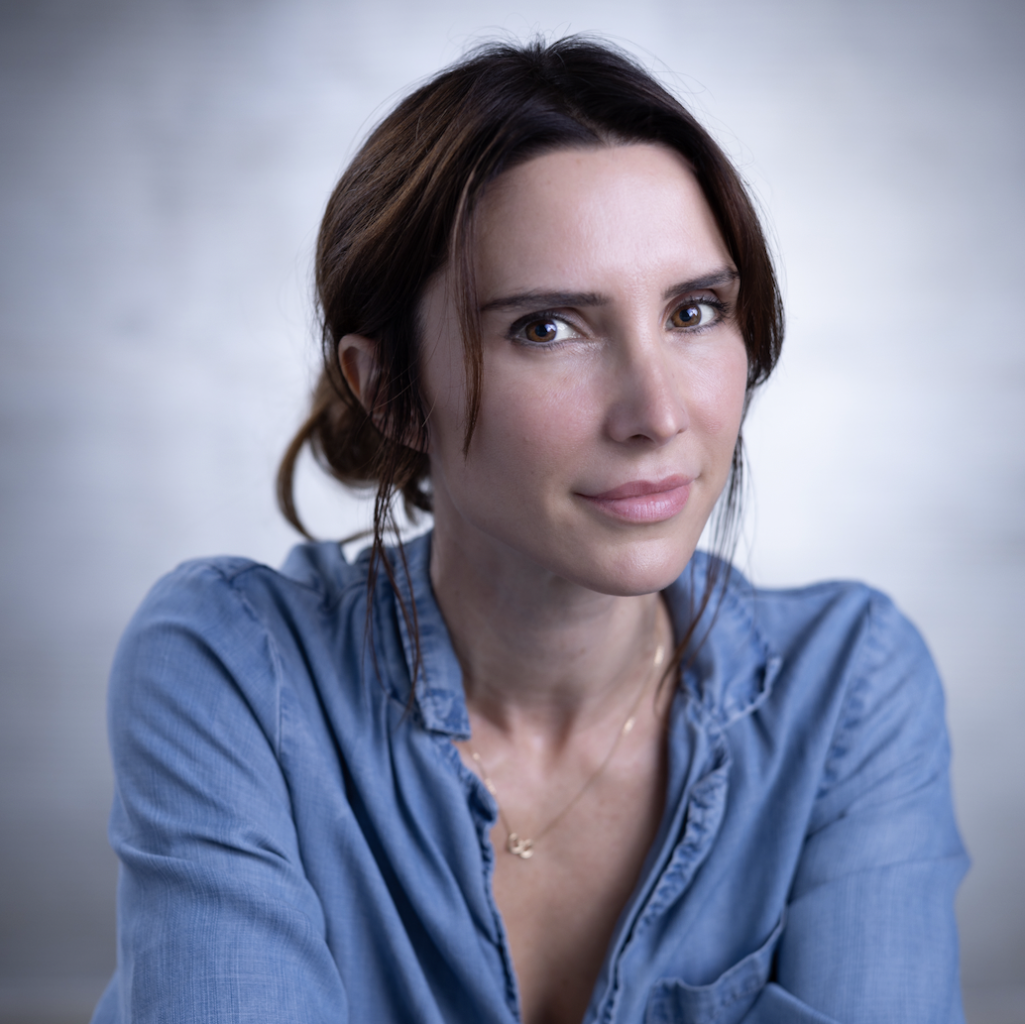
I’m Anaïs Godard with CALYX Press, and today I have the pleasure of speaking with one of the most beloved and influential writers of our time, Julia Alvarez.
Julia left the Dominican Republic for the United States in 1960 at the age of ten. She is the author of numerous novels, essays, children’s books, and poetry collections, including How the García Girls Lost Their Accents and In the Time of the Butterflies, which was selected by the National Endowment for the Arts for its Big Read program. She was the subject of an American Masters documentary, Julia Alvarez: A Life Reimagined, on PBS and was awarded the National Medal of Arts by President Barack Obama. She lives in Vermont.
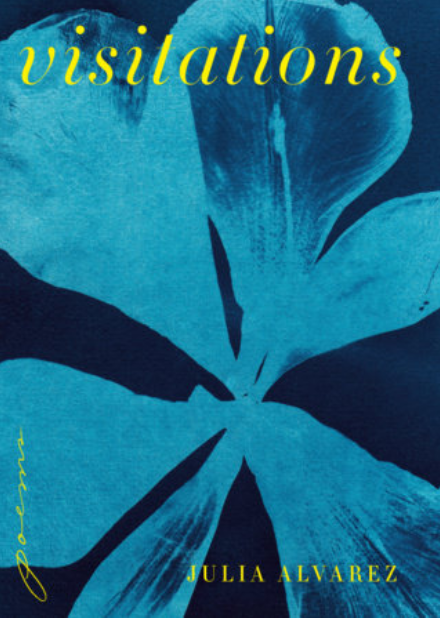
Today we’re here to celebrate her newest poetry collection, Visitations, her first collection of poems in more than twenty years. As someone who came to the United States as an immigrant and now writes primarily in a language that wasn’t my first, I found this collection deeply moving. It feels like a conversation across generations, across languages, and across time itself.
Julia, thank you so much for joining us today.
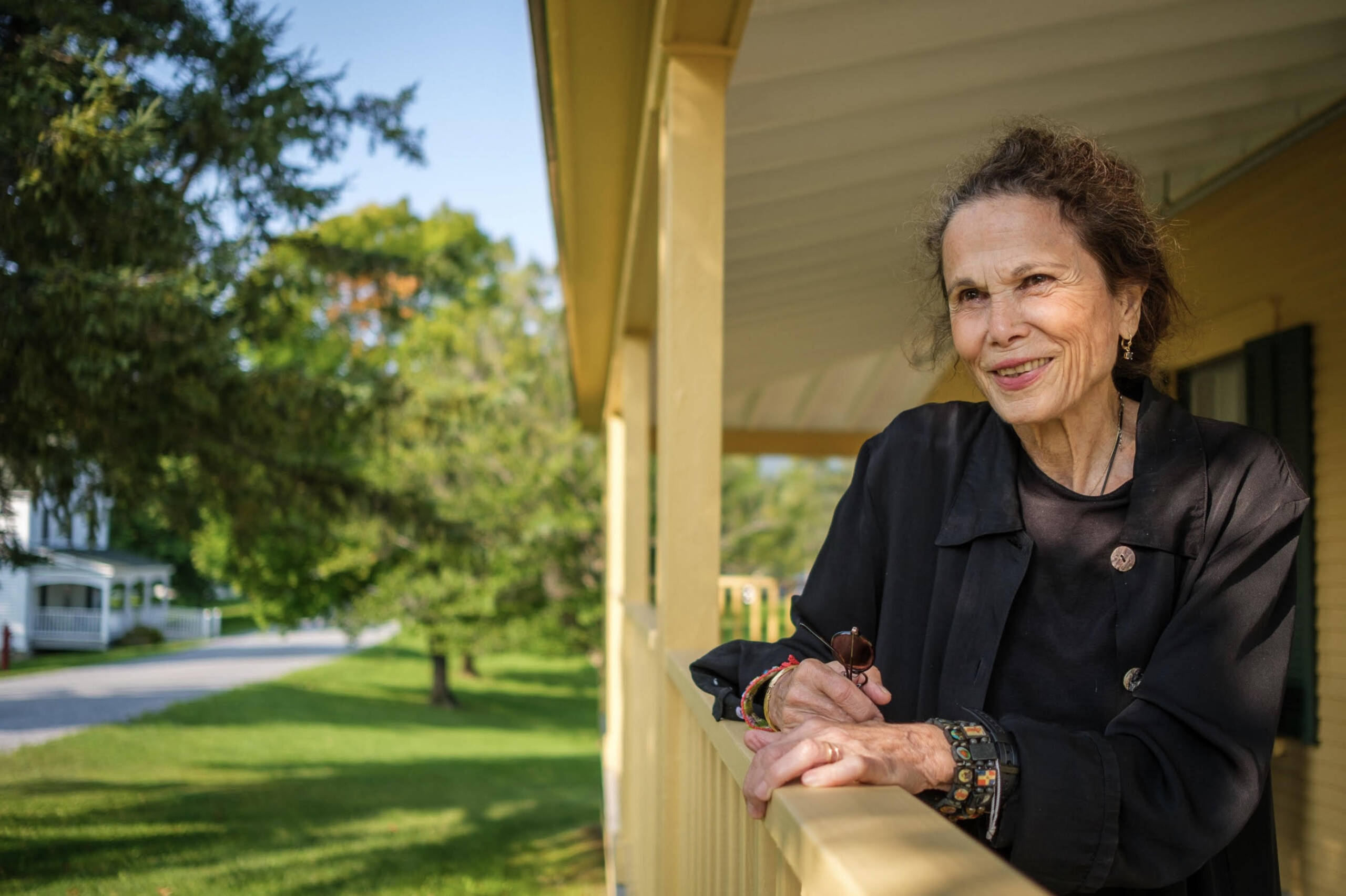
Julia Alvarez: Thank you so much for having me. And thank you to CALYX. I don’t know if you know this, but when I was just beginning, what I call a migrant poet, doing little jobs here and there and trying to find places willing to publish my work, CALYX published some of my very first poems. At that time, multicultural voices and writers from other parts of the world weren’t finding many mainstream publishers or literary magazines willing to take a chance on them. CALYX did. I’ve remained deeply grateful because it was there from the very beginning, paying attention, leaning in, and listening.
On Returning to Poetry, Writing Between Languages, and Listening to the Silence
These are bewildering times. Things often feel as though they’re falling apart. For me, poetry becomes the thread through the labyrinth.
AG: One of the things that struck me in your afterword is that you describe poetry as your first literary love. After more than twenty years away from publishing a collection of poems, what brought you back? Why did this feel like the right moment?
JA: There’s such a root system of answers to that question. Poetry has always been my first love. It’s not something I left behind and then returned to twenty years later. It’s always been there: between novels, in the middle of novels, during difficult moments and joyful ones. I keep returning to poetry because, of all the literary arts, it’s the one closest to silence.
I once heard Seamus Heaney say that poetry is what can’t be put into words. Somehow, through rhythm, incantation, imagery, and repetition, it captures something language alone cannot. I’ve always loved that idea.
As I’ve grown older, I’ve also become more companionable with what Hamlet calls “the rest is silence.” That silence feels increasingly permeable. So many of the people I love have crossed into it already. There are more voices there now than there are here. As you age, those voices begin calling to you, and poetry feels like the form best able to answer.
There’s another reason too. It’s the world we’re living in. These are bewildering times. Things often feel as though they’re falling apart. For me, poetry becomes the thread through the labyrinth. It’s what helps me remember what is essential.
AG: That’s beautiful. When an idea first comes to you, do you know whether it belongs in a poem, a memoir, or a novel?
JA: Sometimes. Sometimes the idea arrives carrying its own DNA. A poem may begin as an image, a rhythm, a phrase that insists on being followed. But as you explore it, a story may emerge. You can begin with a poem and discover you’ve wandered into a short story or a novel. The opposite happens too.
When I was writing In the Time of the Butterflies, I wrote poems in the voice of each Mirabal sister before I wrote their chapters. I needed to hear each woman’s distinct voice, and poetry helped me find it.
So there isn’t a formula for me. Sometimes the work remains exactly what it first declared itself to be. Other times, poetry is simply the trumpet call leading you toward another narrative world.
AG: Listening to you, I hear a great deal of intuition.
JA: Oh, absolutely. It’s a mess.
When I was first getting published, back when CALYX published some of my earliest poems, I used to attend writers’ conferences carrying a notebook, convinced that “real writers” knew exactly what they were doing. I imagined they simply sat down, started at page one, wrote the book, and maybe fixed a few things afterward.
My own process felt hopelessly chaotic.
Only later did I discover that the writers I admired felt exactly the same way. Their process was just as messy. Their self-doubt just as deep. Every new book came with the conviction that they’d never write another one.
Because we’re dealing with mystery.
We’re trying to hold something much larger than ourselves inside our very limited human selves. That means we have to proceed carefully. We have to listen.
Writing Between Languages
Spanish still shapes the way I write English. Sometimes I say I return to poetry because it’s the closest I can come to speaking both languages at once.
AG: One of the things that resonated with me most in Visitations is this sense of living between languages and between cultures. As a fellow immigrant, I recognized that feeling immediately. Do you still find yourself writing between Spanish and English after all these years?
JA: Very much so, although it changes throughout my life. It’s never fixed. At different moments, one language or the other rises to the surface. They’re like those old lava lamps: you never know what shape they’ll take, but both are always there.
And of course, it’s not only Spanish and English anymore. Every person I’ve loved, every book I’ve read, every culture I’ve encountered has become part of me. But at the cellular level, I was formed by the language and rhythms of the Dominican Republic. Spanish taught me how to listen. It gave me my first syntax, my first music.
English is the language I’ve consciously studied and crafted. It’s the language I’ve learned to write in. But Spanish still shapes the way I write English. Sometimes I say I return to poetry because it’s the closest I can come to speaking both languages at once. Poetry is simply a more musical language.
AG: Do you still write in Spanish?
JA: Not really. But there are moments when only a Spanish word can carry exactly the meaning I need. Sometimes it isn’t even the word, it’s the rhythm, the order of the sentence, the music beneath it. Spanish and English have become so intertwined that it’s difficult to separate one from the other.
AG: What do you feel is gained—and perhaps lost—when we write in a language that isn’t the language of our childhood?
JA: That’s the question at the heart of How the García Girls Lost Their Accents.
People often assumed the novel was about losing an accent, but what interested me was what is lost and what is gained when we move between languages.
There’s a loss of complete belonging. In Spanish, I feel grounded in a way that’s impossible to recreate. English is different. I can dive deeply into it, I can even touch the bottom, but I never quite stand there the same way.
Writing in another language always carries a little doubt. You wonder if you’ve truly said what you meant, because some part of your first language always remains just beyond reach. And yet, if I were to write only in Spanish now, something would be missing too. So instead of living with less, I’ve ended up living in a larger landscape. It’s more complicated, certainly, but it’s also richer.
There is another loss, though. When I return to the Dominican Republic, I can’t simply hand my books to relatives who only read Spanish and say, “This is part of me.” That saddens me.
Years ago I compared it to Scheherazade telling stories in the Sultan’s court to survive. You learn to tell your culture’s stories in another language because that’s where you’ll be heard. But you also have to ask yourself: what part of the soul is sacrificed in that translation?
Then there’s another irony. Once you’re celebrated in the United States, you return home carrying a certain privilege. People see you differently. That recognition can separate you from the very community you’re trying to represent.
AG: That sense of existing in between never entirely goes away.
JA: No—but it can also become a bridge.
If we hold on to both languages, both cultures, we can connect worlds. But if we let one go completely, we lose part of ourselves. We cut off our own roots.
AG: I relate to that deeply.
I left France when I was almost seventeen. I didn’t leave because of a dictatorship, but I was running from other hardships. I arrived in London unable to speak English and taught myself through literature.
In many ways, English gave me wings. It gave me another vocabulary, another culture, another way of telling my own story. Reading Visitations, I recognized that bridge you describe. It felt profoundly familiar.
JA: That’s such an important insight.
For many women of my generation, writing in English also brought a kind of freedom. There were stories you simply didn’t tell if you were a “nice girl from a nice family.” Women weren’t expected to have public voices.
Writing in English created a certain distance from those cultural censors. It became possible to write things that might have been impossible to write in Spanish.
Ironically, poetry offered another kind of freedom. The culture I grew up in loved recitations and oral poetry, but people didn’t really read contemporary poetry. My first books were poetry collections, and they were mostly seen as decorative objects, books people displayed on coffee tables.
It wasn’t until I published a novel, and it was translated back into Spanish, that I really got into trouble.
Memory, Dictatorship, & the Present Moment
When I ask myself why I felt compelled to revisit dictatorship, exile, and survival, I think the answer is that I was trying, perhaps unconsciously, to understand the moment we’re living through now.
AG: One thing that surprised me while reading Visitations was how timely it felt.
Throughout the collection, you revisit stories shaped by dictatorship, exile, displacement, and political upheaval. I found myself thinking not only about the Dominican Republic of the past, but also about conversations happening in America today around immigration, belonging, and who gets to tell the story of a nation.
Was that contemporary resonance something you were consciously writing toward, or is it simply the lens through which I’m reading the poems?
JA: I think it became conscious during the editing process.
When I was working on the collection with my editor, John Freeman at Knopf, the final poem wasn’t there yet. One evening, as I was walking through the house turning off the lights, I suddenly realized the book needed to acknowledge the moment we are living through. I told John, “I think this collection has to end with this poem.”
I’ve always loved something the Polish poet Czesław Miłosz once said: a poem doesn’t need to be overtly political or polemical, but poetry that sinks below a certain level of awareness of its own time isn’t very useful to readers.
Imagine writing delicate floral poems while living in Nazi Germany, never allowing the reality outside your window to enter the work. You’ve created a kind of bubble.
Bubble art is like a gated community. It doesn’t let enough of life in.
That doesn’t mean every poem has to be about politics. But whatever we’re writing, the larger world should somehow be reflected within it.
When I ask myself why I felt compelled to revisit dictatorship, exile, and survival, I think the answer is that I was trying, perhaps unconsciously, to understand the moment we’re living through now.
We’re seeing echoes of the very forces my family fled sixty years ago. We came to this country believing it would be a refuge, and suddenly some of those same patterns begin to appear again.
If you’re living with your eyes and your heart open, how could that reality not find its way into your work?
Objects, Symbols & Poetry
The world is already telling stories…. The artist learns to hear them.
AG: One of the things I loved most about Visitations is the way ordinary objects become vessels for memory. I’m thinking of the clocks in “Papi’s Clocks”: the bathrobe, the photographs, the Russian dolls. I couldn’t help noticing how these everyday objects accumulate layers of meaning. Do the objects come first and inspire the poems? Or does the poem come first, with the object becoming symbolic as you write?
JA: Ah, the chicken-and-egg question.
I think if you look at anything in the world with enough attention, careful, surrendered attention, it begins to speak.
There’s a beautiful poem by Gabriela Mistral called “La Contadora” (“The Storyteller”). In it, the whole world is trying to tell its story. She walks past a rock, and the rock wants to speak. She passes a river, an old man, and each one carries a story waiting to be heard.
I think that’s what an artist does. The world is already telling stories. The rock has a story. The river has a story. An old man has a story. The artist learns to hear them. Sometimes it’s an object from childhood. You open a drawer, touch a familiar fabric, smell something you’ve known all your life, and suddenly, like Proust’s madeleine, an entire world returns.
We live through our senses first. Only afterward does the mind organize those experiences into memory.
Take the red bathrobe. Or my grandfather balancing silverware on the dinner table to entertain us.
At first they’re simply memories. But when you listen closely, they begin telling you something larger. My grandfather’s balancing act became a way of understanding the adults around me, people trying to balance terror with joy, dictatorship with childhood wonder. At any moment someone might disappear, and yet they still created magic for us. They made the dining room table into a circus. The silverware became trapeze artists.
That, to me, is extraordinary.
AG: One of the poems that stayed with me most was “The Four Girls.”
There’s a line that stopped me: A poem allows us to look at a thing from all sides at once. Could you talk about that idea?
JA: Even visually, a poem invites that way of seeing. It sits on the page surrounded by white space. You can almost walk around it. A poem doesn’t have all the wonderful constraints of narrative, the fixed point of view, the chronology, the architecture of plot. It remains open.
Different readers can approach it from different directions and discover entirely different meanings.
A novel invites you to inhabit a particular life. A poem gives you enough distance to see that life from many angles at once.
AG: Do you think poetry is especially suited to holding contradictions?
JA: I think all great art does that. The moment art flattens experience into certainty, it stops being art. It becomes propaganda or advertising. Art has to make room for complexity. For contradiction. For what Nikos Kazantzakis called “the full catastrophe” of being alive. Whether it’s a novel, a poem, a painting, or a piece of music, good art refuses simple answers. It reminds us that life is always larger than our explanations.
AG: It feels like something we need now more than ever.
JA: More than ever. Especially at moments when the world wants us to flatten everything into certainty.
Art asks us to remain open.
Women Writers & Literary Community
Journals like CALYX were saying, our bodies, ourselves, our voices, our histories matter.
AG: Visitations also celebrates the power of women gathering together: sisters, mothers, daughters, neighbors. Looking back over your career, what role have women’s communities played in making your work possible?
JA: Before I found a broader Dominican or multicultural literary community, I found feminism. My earliest support came from women’s writing groups. At Syracuse, where all the professors in the creative writing program were men, we started our own women’s writing group. And before that, my first audience was my three sisters. They were the first people who listened.
When I first started writing, I thought I had to write at the level of Homer or Milton—about great campaigns and heroic adventures. I remember a breakthrough during a writers’ residency when I left my room and joined the women working in the kitchen. Listening to them, I suddenly heard my mother and my tías. I went back upstairs and began writing my first group of poems that were truly in my own voice: the Housekeeping Poems.
AG: The magic happened.
JA: Yes. Those women’s voices hadn’t been legitimized. Then, at the same time, the women’s movement was exploding. Journals like CALYX were saying, our bodies, ourselves, our voices, our histories matter. Writers like Adrienne Rich were creating a language for those experiences. They were opening doors.
AG: Even today, what advice would you give young women writers trying to find their own voice?
JA: First, recognize that patriarchy is like a gas. It’s everywhere. We’ve all breathed it in, women as much as men. Those voices that tell you your story isn’t important, that someone else’s story matters more, they’re often inside us before we even begin writing.
Read widely. Find your community. Listen to the voices that make you braver rather than smaller. And above all, trust the stories only you can tell. Be yourself. The world doesn’t need another imitation of someone else’s voice. It needs yours.
Rapid Fire
AG: Before we wrap up, I’d love to end with a little rapid fire. Let’s begin: Poetry or fiction?
JA: Poetry.
AG: Spanish or English?
JA: Spanglish.
AG: Morning writing or night writing?
JA: Morning.
AG: One Spanish word English can never replace?
JA: Gracias. Also, something I really miss is how you can add “ito” at the end of a word.
AG: One English word you wish existed in Spanish?
JA: We don’t have a word in Spanish for insight.
AG: The family storyteller or the family secret-keeper?
JA: Storyteller.
AG: A poem that changed your life?
JA: Ruben Darìo’s A Margarita Debayle.
AG: Which Alvarez sister are you most like today?
JA: All of them.
AG: A word you love?
JA: Inquietude.
AG: If ten-year-old Julia met you today, what would surprise her most?
JA: That I became exactly the person she dreamed of, and that I still don’t have the answers.
AG: Thank you so much Julia for spending this time with us. Visitations is now available. I encourage everybody to pick up a copy: https://www.penguinrandomhouse.com/books/803077/visitations-by-julia-alvarez/.
Anaïs Godard is a Franco-American writer based in Los Angeles, CA, and former television producer who spent a decade interviewing celebrities. She is the 2025 Mike Resnick Memorial Award winner and a Letter Review Prize recipient. Her work has been published in McSweeney’s, Hobart, Fractured Lit, and elsewhere.