
MISBEHAVING AT THE CROSSROADS: ESSAYS & WRITINGS, Honorée Fanonne Jeffers. Harper Collins Publishers, 2025. 368 pages. $30.00 cloth, www.harpercollins.com.
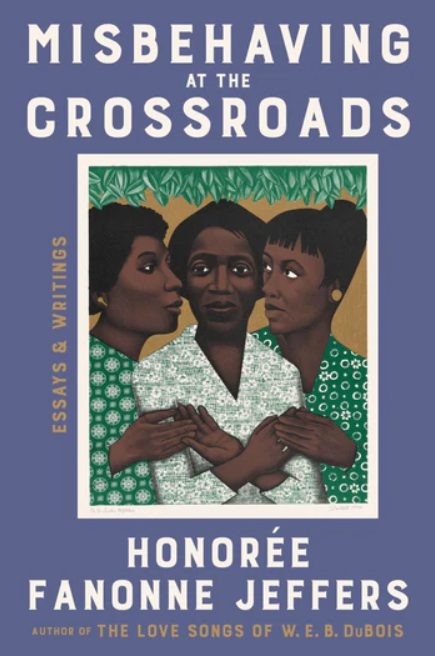
What I admire most about Honorée Fanonne Jeffers’ collection of essays, Misbehaving at the Crossroads, is her critical voice and the intellectual acumen with which she writes on each important topic—from essays on our country’s current political dilemmas to commentary on the literature of the great Toni Morrison. I remember my introduction to this writer’s art through her first novel—The Love Songs of W.E. B. Du Bois—winner of the National Book Critics Circle Award and the Dayton Literary Peace Prize. And I have since become familiar with her work on the early African American poet Phillis Wheatley.
In these powerful essays, Jeffers presents herself as an African American woman at the crossroads. African and Black American cultures represent the crossroads as a place of simultaneous difficulty and potential…. Black women in America stand at a crossroads: attempting to fit into ideas of femininity and respectability formerly assigned only to white women. Yet Black women must still devise strategies to combat their continuing oppression. In Misbehaving at the Crossroads, Jeffers explores the historical and psychological tension in Black women’s lives—both public and private. She writes about her own journey from girlhood to womanhood, the obstacles of racial oppression, the challenges of tracing her ancestry, the adultification of Black girls, Black women in politics, the origins of womanism and Black feminism, and the resistance to white patriarchy and supremacy.
The essays in this important volume are autobiographical, and they are intensely polemical. The woman writes of her search for a personal identity along with the necessity of exploring her consciousness as a writer:
Alice Walker was a woman who (like me) was raised by Black women from Eatonton, Georgia. My mother and she loved each other. Her essays pointed me to a new consideration of women in African American history, and in those moments when I wanted to kill myself, when I would set down that razor or put those pills back into my medicine cabinet—or vomit up the pills I’d swallowed—I didn’t do it for myself. I survived for those Black women who had gone before me. I was determined to live for them, because I knew they had prayed me into being, long before I was conceived. Alice Walker gave those women to me.
– “In Search of Our Mothers’ Crossroads”
Honorée’s mother was a Spelman graduate and a teacher. Alice Walker was one of her students. Honorée turned to Alice Walker’s collection of essays, In Search of Our Mothers’ Gardens, during her turbulent twenties as a vehicle to discover the possibilities of the crossroads of Black and woman. She learned to define womanism: our own brand of feminism—Black feminism. In the 1990s, while reading Alice Walker’s work, she learned to articulate her own worldview: In turn, Honorée writes, I saw myself, who I’d always been and was meant to become. I was no activist. I did not march. I wrote no rage-filled declarations. But I could speak on the page.
I survived for those Black women who had gone before me. I was determined to live for them, because I knew they had prayed me into being, long before I was conceived.
In yet another fierce essay, “Blues for Moynihan,” she foresees the family as the rock-solid foundation of African American life. She attacks the propaganda spread by the data of the 1965 Moynihan Report and subsequent studies of that same nature, which tore at the structure of the Black family. According to Moynihan, the “matriarchal structure” of most Black families hinders Black equality. The study concludes that families headed by males are the only successful model for the Black family. Honorée supports the opponents of “Moynihanism” and offers to her readers autobiographical essays describing her own family’s life with her strong mother and grandmother as the family heads after their separation from her father:
Mama settled the four of us in one large room in a yellow house down the street from her own mother, on Concord Avenue. When my sisters and I walked to Grandma Florence’s house, we passed the residences of our relatives: Aunt Iola, my grandmother’s younger sister who lived across from Mr. Rice’s Funeral Home. Farther down the road was the house of Aunt Iola’s son. […]
…my grandmother was formidable; she was known – and seemingly feared – by everyone in that tiny town’s Black community. Her name was a passport through any dicey situation. Then, too, my mother was a graduate of Spelman College, and that fact alone made her close to a god to every Black person that I encountered in that town.
– “Trellie Lee’s Baby”
Honorée Jeffers’ autobiographical essays about her childhood, coming of age, and the wisdom that arrives with adulthood are complemented by additional essays full of historical fact and sociopolitical detail. She traces the history of her ancestors through census records and personal narratives dating from the time of slavery until the births of her grandmother and her mother. She uses fable and myth to weave the story of the Black woman’s emergence to consciousness, her rejection of any person or movement that would bring further oppression, and the value of the strength of women in maintaining the future of the Black family. This volume represents an important work in redefining the role of Black women in contemporary American society.
Beth Brown Preston is a poet and novelist. A graduate of Bryn Mawr College and the MFA Writing Program of Goddard College, she has been a CBS Fellow in Writing at the University of Pennsylvania and a Bread Loaf Scholar. Her new poetry collection is OXYGEN II (Aquarius Press/Willow Books, 2025) and is nominated for a Paterson Poetry Prize.