
RESIDENTS OF THE DEEP, Marianne Villanueva. Unsolicited Press, Portland, OR, 2025, 198 pages, $18.95 paper, www.unsolicitedpress.com.
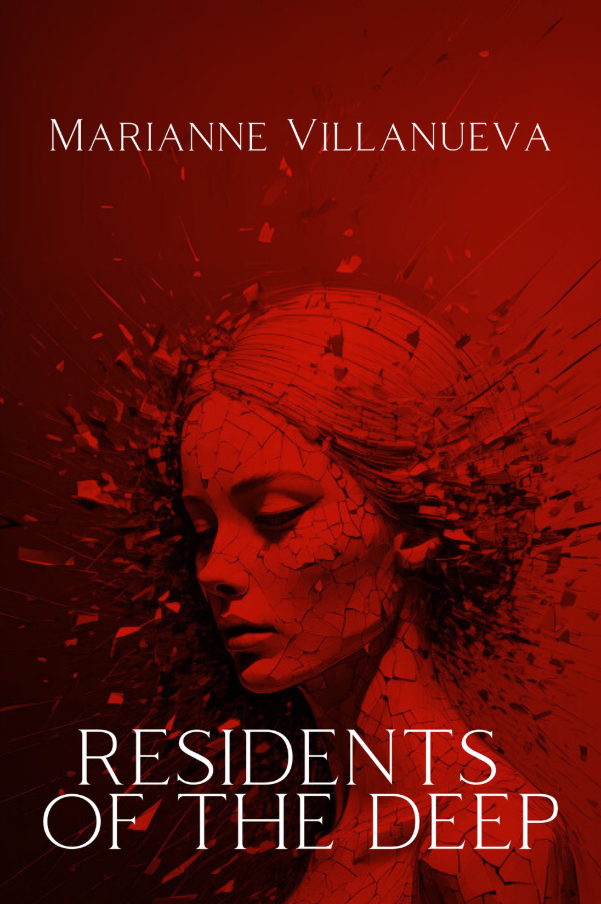
Marianne Villanueva’s Residents of the Deep is a collection of short stories that reads like a shape-shifting archipelago. Each piece is distinct, self-contained, and yet clearly part of a larger submerged formation.
Part myth, part memory, part speculative séance, the book begins innocently enough, rooted in realism: a boy in “Dumaguete” trying to decode the emotional static of his parents’ unraveling marriage. Who was this stranger peering back at him with a frightened expression? It was certainly not he. The line arrives quietly, but it signals the rupture already underway. Identity itself begins to fracture under emotional strain. But then the ground (or the seabed) drops out. With each story, Villanueva pushes us deeper and deeper into estrangement, linguistically, politically, cosmologically, until we’re no longer sure whether we’re reading folklore, dystopia, or an historical record misremembering itself.
Across nearly thirty pieces, Villanueva composes a secret history of the Philippines, not factual but emotional. A history told through the bodies of children, daughters, outcasts, half-mutants, half-mermaids, abused girls, vanished mothers, neglected sons. A chorus of voices that shouldn’t be able to speak to each other and yet do. The father who discovers Atlantis (and promptly forgets his daughter on shore) is part of this lineage of abandonment too, a recurring wound. Men depart. Women endure. Children narrate the aftermath.
The opening story, “Dumaguete,” establishes this pattern early. After a traumatic disappearance, the boy imagines a father who will return and frame the rupture as experience, not loss: “You’ve had an adventure. Wasn’t it fun?” The line is devastating in its casual cruelty. Adventure becomes euphemism; abandonment is rewritten as enrichment. Meaning doesn’t just slip here, it’s actively reassigned, handed down.
This book is a linguistic current. Words mutate. Syntax buckles. In “Spores,” language becomes almost biological, replicating, misfiring, generating new meanings like genetic accidents. Humans are a small and fragile species. But we have the distinction of breeding almost as quickly as microbes. Sex is soporific and palliative. No one would attach a pejorative such as “meaningless” to any form of sexual activity. We are all encouraged to do it as much as possible as late as possible. Grandmothers in their 60’s do it, as well as children as young as 11 or 12. It’s considered a patriotic activity. The rate’s been dropping over the past few decades, though, which is why there is so much emphasis now on breeding and genetics. The language here is clinical, flattening intimacy into policy, desire into duty. Even reproduction is reframed through a vocabulary of efficiency and control.
By the time we reach the colonial retellings near the end—Magellan refracted into alternate histories, islands renamed and claimed and reclaimed—we’re not just watching meaning change; we’re watching meaning erode. A semiotic landslide. It’s as if Villanueva is asking: What survives when language stops behaving? What remains when words decay but stories keep being told?
“You’ve had an adventure. Wasn’t it fun?”
The tonal range of the collection is remarkable: realist mourning, speculative horror, micro-myth, poem, fable, confession, historical hallucination. Even a letter. And yet the progression feels intentional. You can sense the gravity pulling the stories downward, toward the ocean floor. Toward loss. Toward ruin. Toward whatever civilization comes after ours disappears beneath the water. The title story “Residents of the Deep” is a hinge. Atlantis appears as colonial metaphor, a civilization literally submerged under someone else’s narrative. As the narrator reflects, Who knew the greatest discovery I would ever make would involve so simple an act as peering down? Discovery, here, is less about conquest than perspective, about finally seeing what has always been there, ignored beneath the surface.
What deepens the unease is the quiet recognition of resemblance. As far as I could tell, the residents of the City resembled ourselves. The other is not other at all. The submerged civilization mirrors the one above it. The colonial gaze collapses into self-recognition.
But to me, what really ties the entire collection together is Villanueva’s linguistic daring. As mentioned earlier, she treats language like a living organism that is vulnerable to infection, capable of mutation, always carrying traces of earlier forms. The child voices are particularly heartbreaking because they reveal how meaning gets inherited. A misheard phrase becomes belief, a mother’s silence becomes grammar, trauma becomes syntax. In many stories, children speak in the discarded languages of adults: half-truths, half-lies. The vocabulary of neglect. Meaning is always slipping and breaking its own rules. A quiet signal that the world is not what it says it is.
At first I wasn’t sure how to explain the structure of this book. I could feel its shape long before I could map it.Read collectively, the stories behave like a coral reef. Each piece is small and sharp in its own right, but the accumulation, the slow calcification of recurring themes, forms the architecture. Colonialism. Abandonment. The ocean as grave and archive. Violence done to women’s bodies. Time folding in on itself. The planet dying. The way history keeps repeating, sometimes literally sinking. One of the most elegant disaster montages I’ve read.
Villanueva has written a book that refuses to stay in one genre or one century or one vocabulary. It morphs. It leaks. It contradicts itself. And that’s precisely the point. Residents of the Deep makes you think on the instability of narrative. On how families rewrite themselves, how countries overwrite their pasts, how colonizers translate entire cultures out of existence, and how children inherit this linguistic rubble and try to name their world with it.
Nothing in this book stays still. You don’t read Villanueva for certainty. You read her to feel the tremor underneath it, the tectonic shifting of story itself.
And maybe that’s the bigger tale she’s telling: civilizations fall, empires rot, languages collapse, but the deep keeps its residents. Stories survive, even when the words stop behaving.
Anaïs Godard is a Franco-American writer based in Los Angeles, CA, and former television producer who spent a decade interviewing celebrities. She is the 2025 Mike Resnick Memorial Award winner and a Letter Review Prize recipient. Her work has been published in McSweeney’s, Hobart, Fractured Lit, and elsewhere.