
VISITATIONS, Julia Alvarez. Penguin Random House, 1745 Broadway New York, NY 100192026, 112 pages, $27.00 cloth, www.penguinrandomhouse.com.
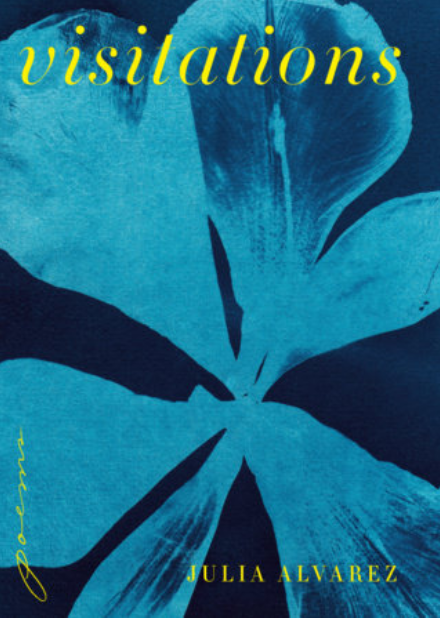
I approached Visitations with a little apprehension.
Poetry and I have always had a complicated relationship. I love it, but I often find myself standing outside it, knocking politely on the door, asking what it means. I’m a linguist and semiotician by training. My instinct is to decode. To follow the trail of breadcrumbs. To find the hidden key.
Julia Alvarez, returning to poetry for the first time in more than twenty years, invited me inside. Not by offering answers, but by reminding me that some things are not meant to be understood. They are meant to be felt.
Though Visitations is a collection of poems, Alvarez remains, at heart, a storyteller. These poems are vivid narrative vignettes, small worlds rendered with such clarity that I could see, smell, and inhabit them. A grandfather carefully cutting a mango with knife and fork. A father whose clocks become a metaphor for his four daughters. A sister running a make-believe restaurant on a Dominican patio. An immigrant girl waiting in a library for a father who suddenly seems smaller in America than he did back home.
Soon she would see for herself when he came in the door
that my father had shrunk since we landed in this country,
nothing drastic at first, but something a kid
used to craning her neck to glimpse his distant face,
the sun blinding her eyes, would surely notice.
Steeping out of that Pan Am flight, he must have sensed
how the scale was shifting, the building getting taller
(“Waiting for My Father to Pick Me up at the Library”)
Many contemporary poetry collections can feel opaque to readers who, like me, arrive searching for a handhold. Visitations is generous. Accessible without being simplistic. Each poem opens a door.
A poem allows us to look at a thing from all sides at once.
The collection’s dedication is to those who leaned in to listen, and that turns out to be the secret architecture of the entire book. In “Recitation,” women gather to hear a child perform a poem. In “My Sister’s Restaurant,” the poet learns the art of how to listen. In “Muse Sighting in Matanzas,” the muse asks not for fame or prestige, but simply for words. Even the title, Visitations, suggests a form of attention: something arrives and asks to be received.
The collection is built from signs. Clocks. Blackboards. Bathrobes. Russian dolls. Photographs. Maps. Flowers. Alvarez turns ordinary objects into meaning-machines. Every object seems to contain a hidden life. In “The Four Girls”, she imagines herself as one of those Russian nesting dolls, a woman who crack[s] open like those hollow dolls / to reveal smaller and smaller selves, until, at the center, remains a tiny figure, terrified and too small to be real. What begins as a toy becomes a meditation on identity, family, and the many selves we carry inside us. The poem also contains what feels like the collection’s guiding principle. In one of its most memorable lines, Alvarez writes:
A poem
allows us to look at a thing from all sides
at once: its open fields, its light
unmodulated by hollows or hills
flushes out the dark complications
so I am who I am here.
That line feels like a manifesto for the entire book.
Poetry, Alvarez suggests, is not a definition. It is not an answer. It is a way of holding contradictions at the same time. Love and resentment. Belonging and exile. Memory and forgetting. The self we were and the self we became.
As a fellow immigrant who now writes primarily in English, I found myself especially drawn to the poems about language. “Erasing the Blackboards, Waiting for My Father to Pick Me Up at the Library,” and “Papi’s Clocks” capture something many immigrants struggle to articulate: not homesickness, exactly, but the experience of living between selves, between systems of meaning. You learn a new language. You gain a new life. But some part of you remains translated rather than transformed.
Alvarez understands that tension intimately. Her poems move between Spanish and English, between the Dominican Republic and the United States, between childhood and adulthood. Yet they never feel nostalgic in a sentimental way. They feel lived.
In the beginning was Spanish: ornate, elegante,
like the dark mahogany furniture I remember
in the houses of tías I visited as a child:
armoires, four-posters, credenzas, mecedoras—
each room like an exhibit in a museum
with Papi as docent of the language of Cervantes.
Then, there was English, painful to hear him speak it,
hacking his way through that thicket of Saxon sounds,
while I followed behind, correcting his errors,
translating him to the baffled Americanos.
(“Papi’s Clocks”)
The collection is also unexpectedly funny. I chuckled more than once. The image of stilettos described as heels on steroids, but also the sly, affectionate self-mockery that runs throughout the book. In “Papi’s Clocks,” Alvarez recalls her father’s collection of clocks, each standing in for one of his four daughters. Of herself, she writes, I suspected I was the second from the left, / the fussy one with the gold-leaf painted door, / the self-important tick tock, off from the others, / demanding special handling and frequent winding. It is both funny and painfully recognizable. Alvarez possesses that rare gift of being profound without becoming solemn, able to move effortlessly between humor and insight. And yet beneath the laughter runs a deeper current.
Then, there was English, painful to hear him speak it, hacking his way through that thicket of Saxon sounds.
I spent much of this collection doing what I always do: looking for meaning. Following symbols. Decoding metaphors. Trying to understand what the clocks, the bathrobes, the photographs, and the Russian dolls were trying to tell me. But somewhere along the way, Visitations performed a small miracle. It persuaded me to stop decoding and start listening. Not every mystery is meant to be solved. Some are meant to be inhabited.
Reading Visitations made me miss people. It made me think about my aging parents, my grandparents who are gone, the family stories that disappeared with them, the questions I forgot to ask. When I finished the collection, I called my mother.
In the end, I don’t think Visitations is really about immigration, language, family, or even memory. It is about time. Again and again, the poems ask the same quiet question: What happens when the people who gave meaning to our lives disappear? That question haunts the grandfather poems. The father poems. The mother poems. The sister poems. The late-life love poems. Yet Alvarez refuses to let absence have the final word. In the title poem, “Visitation” at the end of the collection, she writes: as it sometimes happens out of the blue / a great aunt surfaces in a child’s face, / or a father’s sad eyes return in the eyes / of a dog raising a paw at you. The people we love leave us, but they do not entirely vanish. They linger in gestures, expressions, stories, and unexpected moments of recognition. And somehow, in that persistence, Alvarez finds grace.
In her afterword, Alvarez describes these poems as visitations from selves of the past and present. That feels exactly right. Reading them feels like opening the door to old ghosts and discovering they have not come to haunt you after all. They have come to sit at the table, tell a story, and remind us that while we cannot keep the people we love, we can keep listening.
Lean in and listen.
Anaïs Godard is a Franco-American writer based in Los Angeles, CA, and former television producer who spent a decade interviewing celebrities. She is the 2025 Mike Resnick Memorial Award winner and a Letter Review Prize recipient. Her work has been published in McSweeney’s, Hobart, Fractured Lit, and elsewhere.