
WHEN I SAY THE BONES I MEAN THE BONES, Amanda Hawkins. Wandering Aengus Press, PO Box 334 Eastsound, WA 98245, 2025, 80 pages, $15.94 paper, https://wanderingaenguspress.com.
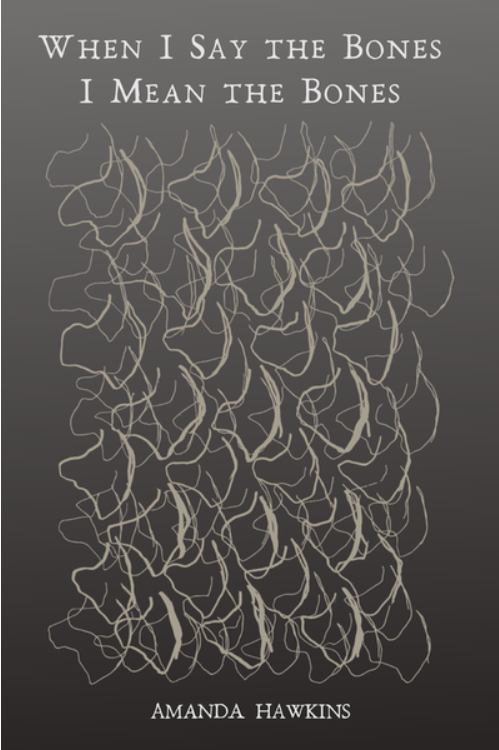
Amanda Hawkins’ When I Say the Bones, I Mean the Bones highlights themes of loss and humanity while exploring how the human beings, like all natural and living things, are interconnected under a shared experience. They do this by presenting readers with the mortal experience against a fragile background; if humans are a piece, then the earth is the puzzle.
The collection consists of three sections delving into the world of life and loss, painting these heavy concepts on backgrounds of cityscapes, landscapes, and seascapes. The first section, At the Base of the Mountain, takes the reader through what Hawkins considers the diminishing lands or places where death is not just a finality, but can be imagined as …both / a body / and a place and the idea that The body / makes the place (“Whale Fall”). This section consists of twelve thought-provoking poems that explore what it means to experience grief.
Following this section is Lessons on Ashes, which talks about the preparation and aftermath of death. Hawkins does this by pulling the etymology of the word cremains and using these pages to dive into how the process of “handling” the dead is deeply ingrained in parts of the natural world; the chemical found in the earth’s crust—breaks / down the body in the water like a body in the earth and that the smell is akin to the ocean. Through these poems, Hawkins takes readers through what it means to process death.
What does it mean when what we seek is silent?
In the last section, titled Fractaline, Hawkins offers a take on how to live with personal loss against a world of violence and ecological crisis. They do this by turning sharply toward religion as a lens for understanding collective grief, ecological destruction, and the limits of human comprehension. Here religion becomes a framework through which the speaker interrogates both historical and contemporary suffering. In “Study Tour,” Hawkins juxtaposes biblical narrative with present-day atrocity, recalling how Moses leads his people out of slavery […] God hardens Pharaoh’s heart and how a darkness spreads itself on the land, / and all the firstborns die, revealing how spiritual imagination can blur the boundaries between victim, witness, and perpetrator.
Later, in “Through High Desert to the Path of Totality,” Hawkins turns to pilgrimage as both longing and futility, observing that [s]ome pilgrims travel to a shrine […] Where did the holy happen and how can we go there again? Yet even this search collapses into doubt with the devastating question: What does it mean when what we seek is silent? Through these intersections of scripture, history, and landscapes, Hawkins uses “Fractaline” to suggest that faith, much like grief, is an unstable terrain, marked by silence, contradiction, and the persistent human need to seek meaning in what remains.
The poems move through simple yet striking images in order to question how to keep looking at death without going numb. In wrapping her book up this way, she invites readers to question the world around them; it’s a grief-forward world, but it is not hopeless. Together, each section pieces together core ideas of the human experience to capture an image of the state of the world. All beings, no matter how big or small, are interconnected in the web of life.”
Alisson Nolan (she/her) is a graduate student at Bridgewater State University, a poet and a writer. They are a High School English teacher from the greater Boston, MA, area. When not studying, she can be found at home reading with her cats, or working on her poetry.